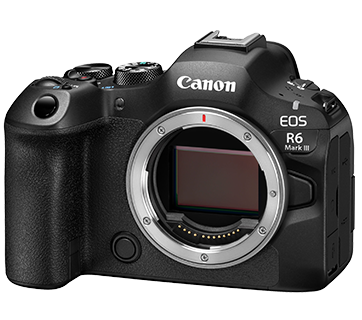
Full Specifications
| Sensor Size | Full frame (35.9 x 23.9 mm) |
| ISO Range | Yes, 100-102400 (expands to 204800) |
| Autofocus Points | 4897 |
| Max Burst Rate (fps) | 40 fps |
| Video Resolution | 4K 120p |
| Image Stabilization | 8.5 stop(s) |
| Weight | 699g |
| Dimensions | 138 x 98 x 88 mm (5.43 x 3.86 x 3.46″) |
| Price (USD) | $2799 |
| Lens Mount | Canon RF |
| Viewfinder | Electronic |
| Screen | 3″, 1,620,000 dots |
| Weather Sealed | Yes |
| Release Year | 2025 |
Pros & Cons
What We Like
- 32.5MP sensor improves image quality and detail over the previous model
- 40fps burst shooting capability enhances action photography and videography
- 7K open gate video recording provides flexibility for cropping and framing in post-production
- Improved autofocus with Dual Pixel CMOS AF II for reliable tracking of subjects
- Better low-light performance with wide ISO range up to 64,000
- User-friendly ergonomics, making it comfortable for extended use
- Weather sealing provides protection in various conditions
What We Don't
- The sensor is not stacked, leading to potential rolling shutter effects in electronic shutter mode
- Increased weight compared to previous models, which may be cumbersome for some users
- Video features, while improved, may be unnecessary for photographers not focused on video
- Only one CFexpress Type B card slot limits redundancy for high-speed video recording
- Some users find that the autofocus can be overly aggressive, leading to misfocused shots
The Verdict
Overall, the Canon EOS R6 Mark III has received positive feedback for its improved resolution, autofocus performance, and video capabilities. However, concerns about its weight, lack of dual card slots, and emphasis on video features may deter some traditional still photographers.
"Everyone is going where the money is, and the money is in social media video."
-- Comment by the editor of Imaging Resource in a review discussion
"40fps burst shot is only with the electronic shutter... you'll likely have some rolling shutter effect."
-- User discussing the performance limitations of the electronic shutter
"If you're shooting a lot of 4K120, FX3 because it has a fan and will never overheat."
-- Discussion on choosing between R6 Mark III and FX3 for video work
"The new R6 III appears to be a significant step up, especially for those focused on video features."
-- General sentiment from multiple users in anticipation of the camera's release
"I'm someone who shoots zero video... just give me a smaller R3 with zero video features."
-- User expressing frustration with Canon's video-heavy focus on new releases
Want the Full Picture?
Read our in-depth review with sample images, real-world testing, and detailed analysis.
Read Full ReviewCompare This Camera
See how the EOS R6 Mark III stacks up against the competition.
Featured In
This camera appears in the following curated lists.
Compatible Lenses
Lenses that work with the Canon EOS R6 Mark III (Canon RF mount).
Similar Cameras
Other cameras in the same segment you might consider.
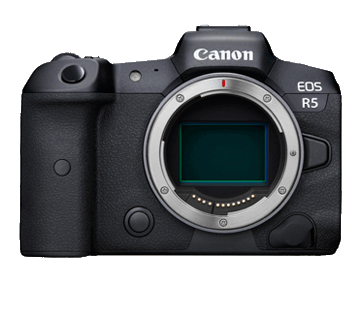
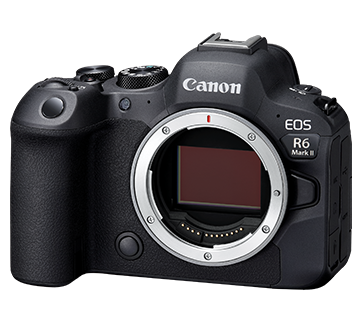
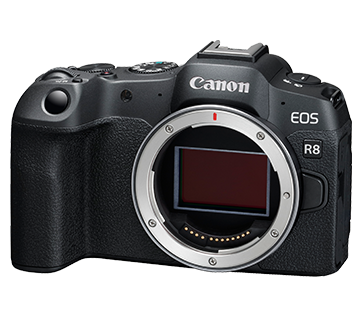
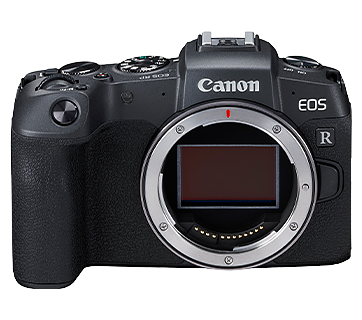


Frequently Asked Questions
Is the Canon EOS R6 Mark III worth upgrading from the R6 Mark II?
If you’re a hybrid shooter or require higher resolution, the R6 Mark III’s improved sensor, faster burst, upgraded autofocus, and expanded video features represent a significant upgrade. However, for dedicated stills shooters, the improvements may be more incremental, making the upgrade less compelling unless you specifically need the new capabilities.
Does the R6 Mark III overheat when recording video?
Yes, extended 4K or high-frame-rate video recording can lead to overheating, restricting continuous recording times. For casual or shorter clips this is rarely an issue, but professional video shooters planning long, uninterrupted sessions should take precautions or consider alternatives.
How effective is the In-Body Image Stabilization (IBIS)?
The IBIS system is rated at up to 8.5 stops and generally works exceptionally well for both stills and handheld video. However, when paired with some wide-angle lenses, users have reported visible wobble or distortion in video footage—something to be aware of if you frequently use wider focal lengths.
Can I shoot high-bitrate video to both cards simultaneously?
No, only the CFexpress Type B slot supports the highest bitrate video recording. Simultaneous recording to both cards is possible at lower settings, but not for all video configurations, limiting professional data redundancy in some workflows.
Is the camera suitable for outdoor professional use?
Yes, the weather-sealed body and robust construction make the R6 Mark III suitable for professional use in challenging field conditions, including event, wildlife, and sports photography.
How does autofocus compare to Sony and Nikon rivals?
The Dual Pixel CMOS AF II system is among the best in the industry, offering fast and reliable subject detection and tracking. It competes closely with Sony’s latest Real-time Tracking and Nikon’s 3D tracking, and may be more intuitive for Canon users upgrading from earlier systems.