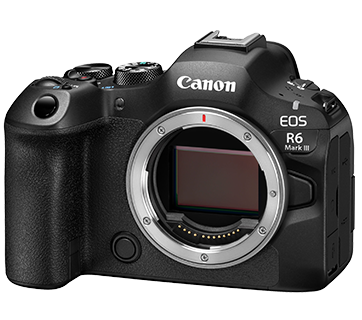
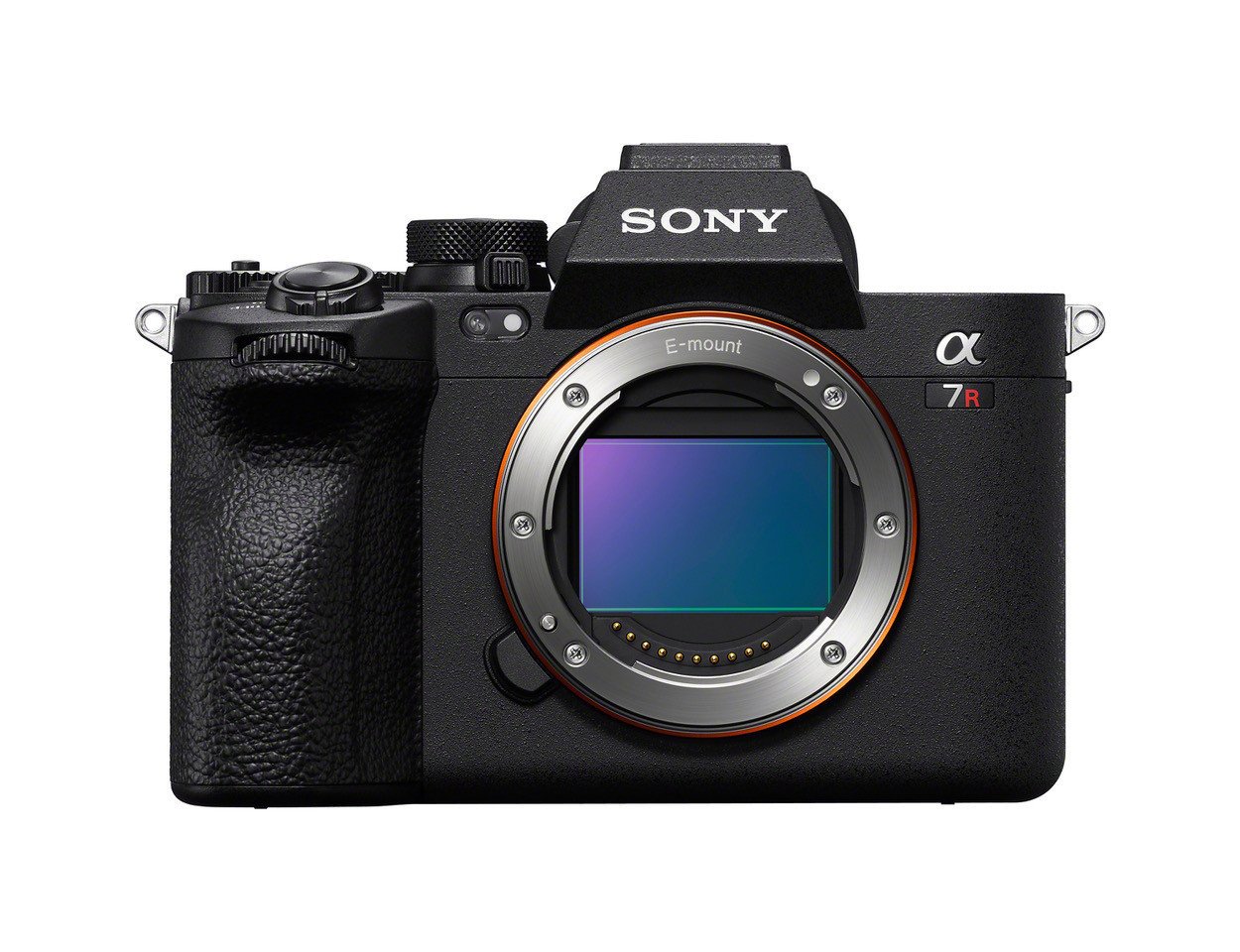
The Canon EOS R6 Mark III and Sony A7R V are two of the most sought-after mirrorless cameras in today's market, appealing to both amateur and professional photographers. Each camera offers impressive specifications and capabilities that cater to a wide range of photography styles, making them frequently compared options for enthusiasts looking for high-performance gear. Canon is traditionally favored for its user-friendly interface and strong low-light performance, while Sony has built a reputation for high-resolution imaging and advanced technical features. Key differentiators between these two models include sensor characteristics, autofocus systems, video capabilities, and overall design features.
Specifications Comparison
Detailed Comparison
Image Quality
The Canon EOS R6 Mark III features a full-frame sensor with a pixel count designed for a wide dynamic range and impressive low-light performance, particularly with its expanded ISO range of 100-102400 (up to 204800). While it doesn't have the highest megapixel count, it delivers excellent color reproduction and noise control, making it suitable for a variety of shooting scenarios.
Conversely, the Sony A7R V boasts a high-resolution 60-megapixel sensor, providing exceptional detail that appeals to landscape and studio photographers who require massive files for prints or cropping. Its ISO range also allows for flexibility in low light, though it is slightly less capable than the R6 Mark III at very high settings (50-102400). This difference can impact the usability of each camera in challenging lighting conditions.
In real-world applications, while the A7R V excels in detail retention, the R6 Mark III offers a more practical balance of performance and usability across a broader range of environments. The choice will depend heavily on the shooting requirements, with the R6 Mark III favoring users requiring strong performance in a variety of situations.
Overall, while both cameras offer remarkable image quality, the Canon's handling of noise at higher ISOs and its better performance in low-light scenarios give it a slight edge for most practical uses.
Autofocus System
The autofocus performance is a critical feature for many photographers, and here both cameras showcase innovation. The Canon EOS R6 Mark III incorporates an impressive 4897 autofocus points, providing nearly complete coverage of the frame, which is optimal for tracking fast-moving subjects-a key advantage for sports or wildlife photography. It also benefits from Canon's renowned Dual Pixel AF technology that delivers precise focus in a variety of conditions.
On the other hand, the Sony A7R V includes 693 phase-detection autofocus points, backed by real-time tracking capabilities that excel in ensuring focus on subjects, particularly in dynamic environments. The Sony system is widely acknowledged for its accuracy, even enabling eye-detection for humans and animals, which is an invaluable tool for portrait and wildlife photographers alike.
While both autofocus systems are top-tier, the sheer number of points on the R6 Mark III can translate to more confident tracking in a broader variety of scenarios, especially at high frame rates. However, the speed and accuracy of focus acquisition on the A7R V may be favored by those who prioritize precision over pixel count.
Ultimately, while both systems are exemplary, for those focused mainly on sports and action, the Canon R6 Mark III's advanced focusing capabilities may provide the upper hand.
Video Capabilities
In terms of videography, the Canon EOS R6 Mark III offers robust features, including 4K recording at 120p, which allows for impressive slow-motion playback while maintaining high resolution. Additionally, the inclusion of 8.5 stops of in-body image stabilization makes it an attractive option for handheld shooting.
The Sony A7R V, on the other hand, records 4K video at 60p. While this is sufficient for traditional video applications, the limitation may not suffice for creators looking for extreme slow-motion effects or high frame-rate options. It also offers 8 stops of stabilization, which is slightly less than Canon's offering.
Although both cameras are suitable for at least semi-professional video work, the R6 Mark III's higher frame rates and enhanced stabilization create a more versatile system for videographers who require fluid and detailed motion capture.
Considering these factors, the Canon R6 Mark III stands out as the superior choice for video production.
Build & Ergonomics
Both cameras are built with high durability and weather-sealing, making them suitable for outdoor photography. The Canon EOS R6 Mark III features a slightly bulkier design at 699g, providing a grip that many users find comfortable during prolonged shooting sessions. Its dimensions (138 x 98 x 88 mm) also suggest a solid construction that withstands rugged environments.
In comparison, the Sony A7R V is a bit lighter at 723g, with slightly smaller dimensions (131 x 97 x 82 mm), which can be beneficial for portability. Its layout is ergonomic but tends to be a little more favorable for users with smaller hands, especially with its dial placements. The screen on the A7R V has a higher resolution (2,100,000 dots compared to 1,620,000 dots on the R6 Mark III), providing more detail for reviewing images on the go.
User preference plays a significant role in ergonomics, with some opting for Canon's bulkier build for aesthetics and grip while others prefer the slightly more compact and lighter feel of the Sony. Ultimately, both systems have their advantages in build quality, targeting different user needs.
In this category, it's a tie as both manufacturers deliver robust and well-thought-out designs suitable for their intended use cases.
Battery & Storage
Battery life is an essential consideration for photographers on extended shoots. The Sony A7R V boasts a commendable battery life with approximately 530 shots per charge, supporting its users during long sessions without needing a recharge. This is particularly beneficial for users working in remote locations.
The Canon EOS R6 Mark III does not publicly specify battery life in terms of shots, but it is generally understood to offer performance in line with Canon's other models. Nonetheless, it has made advancements in efficiency, especially when considering the extensive usage of its faster burst modes.
When discussing storage, Sony provides options for dual card slots within its system that can accommodate CFexpress Type A and SD UHS-II cards. The Canon also features dual slots but may provide broader compatibility across a wider variety of card systems.
The wider battery lifespan of the A7R V makes it a more reliable choice for extensive projects without the immediate need for charging. Thus, when considering battery and storage, the award goes to the Sony A7R V.
Value for Money
With a price point of $2799, the Canon EOS R6 Mark III is relatively more affordable compared to the Sony A7R V, priced at $3900. This price difference makes Canon's offering more accessible to hobbyists and those wanting a high-performing camera without the entry barrier associated with high-resolution models.
The added cost for the Sony A7R V reflects its high-resolution sensor and advanced video features, catering specifically to professionals or enthusiasts who need superior detail and versatility. It offers a more extensive feature set that can justify the price for those who will be maximizing these capacities.
However, for many buyers, the Canon R6 Mark III provides a balanced package-boasting excellent image quality, superior autofocus, and better video capabilities at a more approachable price point. It stands out as an appealing option for individuals who may not require the ultra-high resolution of the A7R V but are still looking for high performance across various disciplines.
Considering the specifications and target audience, the Canon EOS R6 Mark III represents better value for most photographers looking for versatility and quality without overspending.
Our Verdict
Overall, the Canon EOS R6 Mark III wins this comparison, excelling in essential categories such as image quality, autofocus capabilities, and video performance. Its price point further enhances its appeal, presenting a highly capable option that doesn't compromise on essential features. While the Sony A7R V is an outstanding camera with impressive resolution and craftsmanship, the additional cost and use case sophistication restrict its audience. For those prioritizing low-light performance, fast action, and value for money, the R6 Mark III is clearly the better choice. Conversely, the A7R V serves those photographers whose primary focus is on high-resolution image capture and advanced video options.
Canon EOS R6 Mark III
Sony A7R V
Also Compare
Frequently Asked Questions
Does the A7R V's higher pixel count make it better for landscape photography?
In many cases, yes. The higher megapixel count of the A7R V provides the ability to capture finer details in landscape photography, making it suitable for large prints or extensive cropping. However, the R6 Mark III excels in dynamic range and low-light scenarios, which may also be significant factors depending on the conditions.
Is video quality better on the R6 Mark III?
The R6 Mark III offers superior video capabilities with up to 4K 120p, compared to the A7R V's 4K 60p. If high frame rates and superior stabilization are critical for your video work, the R6 Mark III would be the better choice.
Which camera is better for wildlife photography?
While both cameras can handle wildlife photography, the Canon R6 Mark III has a significant advantage with its superior autofocus points and faster continuous shooting speed (40 fps) compared to the 10 fps of the A7R V, making it more effective for capturing fast-action shots.
Can I use lenses from other brands with these cameras?
Yes, while both Canon and Sony offer proprietary lens systems, there are adapter options available for using lenses from other brands. However, performance may vary depending on the adapter and lens compatibility.