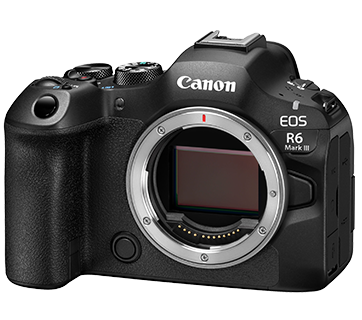

The Canon EOS R6 Mark III and Sony ZV-E1 are two premium full-frame mirrorless cameras that cater to videographers and photographers alike. Canon's R6 Mark III appeals to professionals looking for high performance in both still images and video, while Sony's ZV-E1 is designed with content creators in mind, focusing on user-friendly features and compact size. Both cameras offer impressive specifications, making them prime candidates for users who need versatile tools for high-quality video and photography.
Specifications Comparison
Detailed Comparison
Image Quality
The Canon EOS R6 Mark III boasts a larger full-frame sensor (35.9 x 23.9 mm) that offers outstanding image quality across its ISO range of 100-102400 (expandable to 204800). The increased number of autofocus points (4897) allows for excellent subject tracking and overall sharpness. Furthermore, the high resolution and improved color science add to the overall quality, particularly beneficial for photographers working in varying lighting conditions. In contrast, the Sony ZV-E1 has a slightly smaller full-frame sensor (35.6 x 23.8 mm) and is rated at 12 megapixels. While it has an ISO range of 80-102400 (expandable to 40-409600), which gives it vibrant low-light performance, the lower resolution might not capture as much detail compared to the Canon R6 Mark III's potential. The autofocus system, while robust with 759 points, offers different strengths that may favor fast-action shooting or video. Overall, while both cameras deliver exceptional image quality, the R6 Mark III's resolution and image processing tend to give it an edge in still photography scenarios, particularly in dynamic conditions.
Autofocus System
Autofocus is critical for fast-paced photography and videography, and both the Canon EOS R6 Mark III and Sony ZV-E1 excel in this area but with different advantages. The R6 Mark III features a groundbreaking 4897 autofocus points, which makes its subject acquisition and tracking capabilities among the best in the market, ensuring that moving subjects remain in focus, an essential feature for both photo and video work. On the other hand, the Sony ZV-E1 integrates a highly capable autofocus system with 759 points, which is also fast and reliable. Sony's Real-Time Eye AF technology allows for remarkable precision, especially in video, making it highly appealing for vloggers and content creators focused on capturing engaging footage. Though both systems are robust and serve their intended purposes, the slight edge in autofocus point coverage and performance shifts the balance towards the Canon EOS R6 Mark III for photographers working in diverse conditions, while the ZV-E1 shines for dynamic video applications.
Video Capabilities
For videographers, the capabilities of a camera are paramount, and in this category, the Canon EOS R6 Mark III offers advanced features like 4K video at 120p, making it ideal for slow-motion footage and high-frame-rate applications. Its built-in 8.5 stops of stabilization provides smoother handheld shooting, a significant advantage for action shooters and run-and-gun filmmakers. Comparatively, the Sony ZV-E1 provides 4K video at a maximum of 60p, which is still excellent for most applications, though it may not meet the requirements for those seeking ultra-slow-motion capabilities. The ZV-E1 also features 5 stops of stabilization, which, while effective, does not match the Canon's performance. However, the ZV-E1 compensates with a user-friendly interface and features tailored for vloggers, such as a fully articulating touchscreen and enhanced audio options. Considering all factors, the Canon EOS R6 Mark III earns the top spot for videographers aiming for the highest resolutions and frame rates, while the Sony ZV-E1 provides a more straightforward experience for casual video creators.
Build & Ergonomics
When it comes to build quality, both cameras showcase weather-sealed designs, ensuring that they can withstand various environmental conditions. The Canon EOS R6 Mark III, with its larger dimensions (138 x 98 x 88 mm) and weight (699 g), has a sturdy feel in hand, providing a good grip for extended use but may be less portable for travel. In contrast, the Sony ZV-E1 is notably lighter (483 g) and more compact (121 x 72 x 54 mm), which makes it a favorite among vloggers and those frequently on the go. Both cameras feature a touchscreen, but the ZV-E1's 3" touchscreen has a slightly lower resolution (1,036,800 dots) compared to the R6 Mark III (1,620,000 dots), providing better detail on Canon's display. Overall, while the R6 Mark III appeals to those who favor durability and handling for professional use, the ZV-E1's compact size and ergonomics lend themselves well to travel and mobile shooting scenarios.
Battery & Storage
Battery performance can be crucial for all-day shoots, and here the Sony ZV-E1 shows impressive stats with a battery life of approximately 570 shots per charge, which tends to offer more flexibility for extended use and logging without constantly swapping batteries. The R6 Mark III, while powerful, may not reach the same shot count, though specific details about its battery life aren't specified. Both cameras support high-capacity storage through CFexpress and SD cards, enabling users to capture high-resolution video and burst shooting. Furthermore, the Canon's ability to shoot 4K at 120p would likely demand faster storage solutions as well. Despite both cameras offering decent battery and storage capabilities, the ZV-E1's longer battery life could be attractive for users frequently recording without the need to replace batteries, making it an appealing option for content creators.
Value for Money
In terms of pricing, the Canon EOS R6 Mark III retails for approximately $2799, positioning it as a professional-grade option packed with features and superior performance for both photographers and videographers. Its higher price point can be justified by its advanced capabilities, solid build, and exceptional autofocus. On the contrary, the Sony ZV-E1 comes in at a more accessible price of $2200, making it an attractive choice for beginners or hobbyists looking to jump into full-frame videography without the steep investment. The ZV-E1 also includes features tailored specifically for content creation, adding to its overall value proposition. While both cameras provide excellent performance, the choice between them boils down to how much you're willing to invest for additional capabilities. The R6 Mark III could be seen as a better long-term investment for serious pros, whereas the ZV-E1 provides robust features for the price.
Our Verdict
Overall, while both the Canon EOS R6 Mark III and Sony ZV-E1 have their respective strengths, the R6 Mark III edges out as the preferred choice for users requiring superior image quality, autofocus performance, and video capabilities. It is ideal for professionals engaged in diverse photography and videography scenarios. In contrast, the Sony ZV-E1 excels in portability and value, making it the better option for casual content creators and vloggers who prioritize ease of use and are working within a budget. Each camera has a rightful place depending on the intended use case.
Canon EOS R6 Mark III
Sony ZV-E1
Also Compare
Frequently Asked Questions
Which camera is better for low-light photography?
The Canon EOS R6 Mark III generally provides better low-light performance due to its higher resolution and larger sensor capabilities, making it a suitable choice for challenging lighting conditions.
Is the R6 Mark III worth the higher price?
If you are a professional photographer or videographer needing advanced features and outstanding image quality, the investment in the R6 Mark III can be well justified. However, for casual users, the ZV-E1 can still deliver great performance at a lower cost.
Which camera has better video capabilities?
The Canon EOS R6 Mark III takes the lead with 4K video at 120p, offering greater versatility in terms of slow-motion shooting when compared to the Sony ZV-E1's 4K at 60p.
Can either camera be used for vlogging?
Yes, both cameras can be used for vlogging. The Sony ZV-E1 is particularly geared towards vloggers with its lighter weight, user-friendly features, and excellent audio options, while the R6 Mark III offers superior image quality.
What is the autofocus performance like in each camera?
The Canon EOS R6 Mark III features 4897 autofocus points, great for complex tracking of moving subjects, while the Sony ZV-E1 has 759 points that are fast and accurate, particularly for video applications.