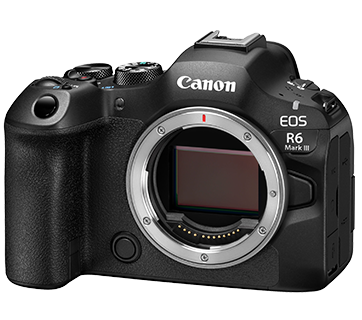

The Canon EOS R6 Mark III and the Sony A9 II are both exceptional full-frame mirrorless cameras that appeal to a wide range of photographers, particularly sports, wildlife, and event shooters. With advanced technology and innovative features, these models are often compared by enthusiasts and professionals alike. The key differentiators between these two cameras lie in their autofocus capabilities, continuous shooting speed, video performance, and overall user experience, influencing buyers' choices based on their specific needs and shooting styles.
Specifications Comparison
Detailed Comparison
Image Quality
The Canon EOS R6 Mark III features a full-frame sensor (35.9 x 23.9 mm) that excels in producing high-quality images with a wide ISO range of 100-102400, which can be expanded to 204800. This allows for outstanding performance in low-light conditions, an area where Canon traditionally shines. Coupled with its Dual Pixel CMOS AF system, the R6 Mark III delivers impressive image clarity and color accuracy across a variety of lighting scenarios.
In contrast, the Sony A9 II sports a slightly smaller full-frame sensor (35.6 x 23.8 mm) and has a lower native ISO range of 100-51200 (expandable to 50-204800). While the sensor's performance is commendable, the differing pixel count of 24 megapixels (A9 II) compared to what might be expected of the R6 Mark III suggests potential differences in fine details and crop-ability.
Therefore, for photographers placing a premium on image quality and versatility, the R6 Mark III may hold the upper hand due to its broader ISO capabilities coupled with advanced processing algorithms that yield stunning results even at extreme settings.
While both cameras capture high-quality images, the slightly enhanced performance in Canon's R6 Mark III gives it the edge in this category, especially for those needing versatility in varied lighting conditions.
Autofocus System
The autofocus system is crucial for fast-moving subjects, and both cameras deliver exceptional performance in this area. The Canon EOS R6 Mark III boasts a remarkable 4897 autofocus points, translating to high precision and responsiveness in tracking subjects, an essential feature for sports and wildlife photography. Canon's Dual Pixel autofocus technology ensures sharp focus even in challenging conditions.
Meanwhile, the Sony A9 II offers 693 autofocus points, which are also remarkably advanced, benefiting from Sony's renowned Eye AF technology. This functionality is particularly advantageous for portrait photographers or those capturing candid moments, as it allows for accurate focusing on subjects' eyes even with quick subject movement.
Ultimately, while the A9 II's autofocus system is renowned for its real-time tracking capability, the R6 Mark III's larger number of points may provide more versatility and coverage, especially in complex shooting scenarios. Thus, this round slightly favors Canon's offering, primarily due to its higher number of detection points and overall tracking accuracy.
Both systems are top-tier, but the edge goes to the Canon EOS R6 Mark III for its broader autofocus point coverage, making it more suitable for unpredictable action scenes.
Video Capabilities
When it comes to video performance, both cameras cater to different types of videographers. The Canon EOS R6 Mark III supports impressive 4K video recording at up to 120p, allowing for high-quality slow-motion effects and unparalleled resolution. The ability to shoot high frame rates without a crop is a significant advantage for creators seeking the best video quality.
On the flip side, the Sony A9 II offers 4K video recording but is limited to 30p. While its quality is excellent, the lower frame rate and crop factor make it less appealing for those looking to produce high-frame-rate or slow-motion footage. Sony has firmly positioned itself as a leader in video technology, but in this case, the capabilities of the R6 Mark III are more advanced.
For those whose work demands cutting-edge video functionalities, the R6 Mark III clearly outshines the A9 II due to its superior video resolution capabilities and high frame rate options.
Thus, in terms of video features, the Canon EOS R6 Mark III is the winner, strongly appealing to filmmakers and video creators.
Build & Ergonomics
Both the Canon EOS R6 Mark III and Sony A9 II feature robust, weather-sealed bodies built for durability in adverse conditions. The Canon's dimensions are slightly larger at 138 x 98 x 88 mm compared to the A9 II's 129 x 96 x 76 mm, which may influence portability for some users. However, the extra weight of the R6 Mark III at 699g versus the A9 II's 678g offers a perceived durability advantage without compromising comfort during extended shooting sessions.
Ergonomically, the Canon R6 Mark III is often praised for its design and intuitive layout, making it a favorite amongst those who value usability and comfort. The grip is substantial, allowing for a secure hold, especially beneficial when using larger lenses.
Sony's A9 II, however, is known for its compact design and lightweight profile. It may appeal more to buyers looking for a portable, streamlined option for travel or event photography.
In conclusion, while both cameras excel in build quality, the choice may boil down to personal preference regarding size and ergonomics, offering a tie in this section.
Battery & Storage
The battery life is another critical aspect for photographers who often shoot long sessions. The Sony A9 II leads here with a remarkable battery life of approximately 690 shots per charge. This feature is particularly useful during events or extended travel where charging options may be limited, making it a reliable companion for professional use.
In comparison, the Canon EOS R6 Mark III's battery life is not explicitly stated but is likely comparable, given its newer release and enhancements in battery technology. However, it does not reach the same level as the A9 II in terms of longevity.
Additionally, it is worth mentioning the storage options. Both models support dual-card slots, which is vital for high-volume shooting scenarios. Users can choose between various storage formats to facilitate backup and organization, an essential aspect for any serious photographer.
Thus, for battery life, the A9 II takes the lead, reflecting its stronger performance in this critical area of usability.
Value for Money
When considering price, the Canon EOS R6 Mark III is priced at $2799 while the Sony A9 II comes in at $4500. The R6 Mark III offers exceptional features at a competitive price, making it an attractive option for those who want high performance without breaking the bank. It provides excellent value, especially for videographers who benefit from its superior video capabilities and improved image quality.
On the other hand, the Sony A9 II, while more expensive, is designed for professional photographers who prioritize quick shooting and real-time autofocus performance. Its robust build and excellent battery life further justify its higher price tag to some professionals.
The value proposition also varies depending on the specific needs of the user. For those primarily focused on action photography with the latest technologies, the A9 II is a sound investment. However, for those seeking an all-around performer with significant video capabilities, the R6 Mark III represents superior value.
Consequently, given its competitive pricing for the features it offers, the Canon EOS R6 Mark III provides a better overall value for the average consumer, making it the winner in this segment.
Our Verdict
Overall, the Canon EOS R6 Mark III emerges as the winner in this comparison, excelling in image quality, autofocus performance, video capabilities, and value for money. It is a robust choice for photographers and videographers alike. However, the Sony A9 II remains a strong contender, especially for those focused on high-speed shooting and long battery life. The choice ultimately boils down to specific requirements: for those who heavily emphasize video quality and versatility, the R6 Mark III is unparalleled, while the A9 II will appeal to professionals seeking unmatched continuous shooting performance.