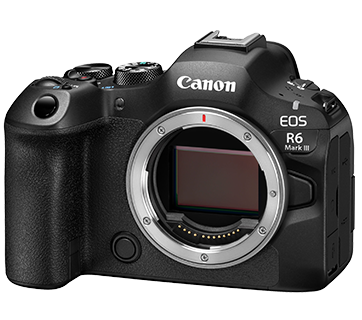
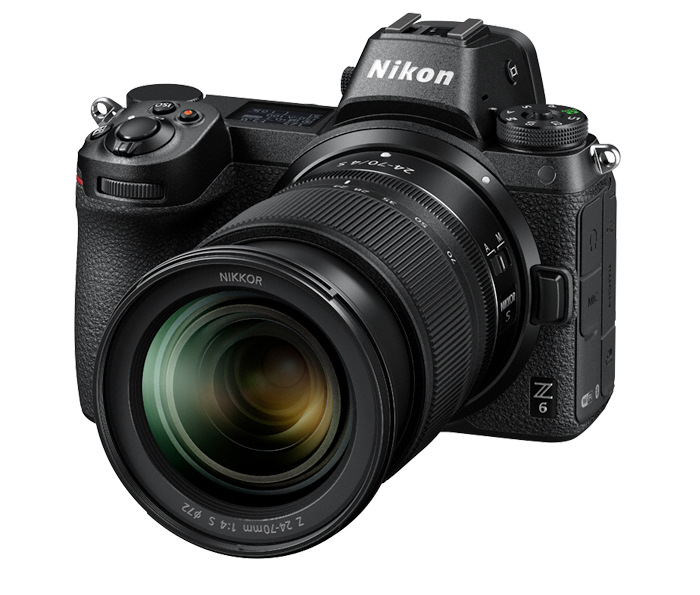
The Canon EOS R6 Mark III and the Nikon Z6 are two noteworthy full-frame mirrorless cameras that have attracted the attention of enthusiasts and professionals alike. Both models represent their respective brands' commitment to quality and performance, making them commonly compared options for photographers and videographers looking to invest in versatile gear. Those who might be choosing between these two models typically include hybrid shooters who appreciate the balance between stills and video capabilities, as well as those seeking advanced autofocus systems and robust build quality in their cameras.
Specifications Comparison
Detailed Comparison
Image Quality
Both the Canon EOS R6 Mark III and the Nikon Z6 sport full-frame sensors, which allows for excellent image quality and low-light performance. The R6 Mark III has an impressive ISO range of 100-102400, expandable to 204800, giving it a significant advantage in low-light scenarios compared to the Z6's ISO range of 100-51200 (expands to 50-204800). Although the Nikon Z6 has a resolution of 25 megapixels, the Canon R6 Mark III leverages its higher ISO capabilities to produce clearer images in challenging conditions. Notably, the details maintained at high ISO settings can influence the final output quality, especially in professional work. Overall, the R6 Mark III might edge out the Z6 due to its superior low-light performance, enhancing overall image fidelity in various scenarios.
Autofocus System
The autofocus system is critical for both stills and video, and here, the Canon EOS R6 Mark III shines significantly. Featuring an astonishing 4897 autofocus points, it employs advanced face and eye detection that smooths out tracking during both photography and videography. In comparison, although the Nikon Z6 comes equipped with 273 autofocus points, it cannot match the sheer speed and accuracy provided by the R6 Mark III in fast-moving scenarios. Canon's latest algorithms also enhance performance under low-light conditions, allowing for reliable focus acquisition in dim environments, establishing the R6 Mark III as the leader in autofocus capabilities.
Video Capabilities
When it comes to video capabilities, the Canon EOS R6 Mark III leads with a max video resolution of 4K at 120 frames per second, allowing for stunning slow-motion footage and high frame rate recording, making it ideal for filmmakers. In contrast, the Nikon Z6 supports 4K video at a maximum of 30 frames per second, which is sufficient for many users but lacks the versatility that the R6 Mark III offers. The Canon model also includes advanced features such as 10-bit 4:2:2 internal recording, giving videographers greater flexibility in post-production. Therefore, for professionals focused on video, the choice leans heavily towards the Canon R6 Mark III for its superior specs.
Build & Ergonomics
Both cameras sport excellent build quality and are weather-sealed, making them suitable for challenging shooting conditions. The Canon EOS R6 Mark III weighs in at 699 grams against the Nikon Z6's lighter 675 grams. Although the differences in weight are minimal, the ergonomics of the two can shape the shooting experience. The Z6 has a slightly larger screen at 3.2 inches with 2,100,000 dots compared to the R6 Mark III's 3-inch 1,620,000 dots, offering sharper visual feedback. However, the R6 Mark III's design focuses on enhanced handling, with a slightly more robust grip, which can be a crucial factor for users shooting for extended periods. Overall, both have ergonomic designs, but the differences may come down to personal preference regarding handling.
Battery & Storage
The Nikon Z6 scores higher in battery life, rated at approximately 310 shots per charge, compared to the Canon EOS R6 Mark III, which does not specify a shot count but generally offers a lower endurance. This can become an important consideration for professionals during extended shooting sessions. Storage options are also worth discussing. Both cameras support CFexpress and SD card formats, with the R6 Mark III benefiting from faster memory write speeds which further facilitate its high-speed shooting capabilities. Hence, while the Z6 offers better battery longevity, the R6 Mark III compensates with advanced storage functionality and performance.
Value for Money
The Canon EOS R6 Mark III is priced at $2799 while the Nikon Z6 is more affordable at $1995. This price difference can play a significant role for buyers on a budget, particularly amateur photographers or casual enthusiasts. However, when considering the features and performance offered by each camera, the R6 Mark III justifies its higher price point through superior autofocus, faster video capabilities, and enhanced low-light performance. Nevertheless, for users who prioritize budget, the Nikon Z6 presents a compelling offer, particularly with its solid performance and reliable image quality. Overall, while the Canon offers more features for professionals, the Nikon remains an excellent value for enthusiasts.
Our Verdict
The comparison between the Canon EOS R6 Mark III and the Nikon Z6 illustrates clear distinctions favoring the Canon model, particularly in areas critical for high-performance photography and videography, including autofocus and video capabilities. While the Nikon Z6 offers adequate features and significant value for entry-level enthusiasts, the advancements and specifications of the R6 Mark III-especially for hybrid shooters-make it the overall champion. However, for those whose primary concern is budget and battery reliability, the Z6 remains a valuable contender.
Canon EOS R6 Mark III
Nikon Z6
Also Compare
Frequently Asked Questions
Which camera is better for low-light photography?
The Canon EOS R6 Mark III offers a superior ISO range and noise performance, making it more effective for low-light photography compared to the Nikon Z6.
How do the video capabilities compare?
The Canon EOS R6 Mark III supports 4K video at up to 120fps, while the Nikon Z6 supports 4K up to 30fps, making the R6 Mark III the better choice for video work.
Is the Nikon Z6 a good choice for beginners?
Yes, the Nikon Z6, with its lower price point and solid performance, makes it an excellent choice for beginners looking to enter full-frame photography.
Which camera is better for action photography?
The Canon EOS R6 Mark III excels in action photography due to its fast autofocus system and high burst rate at 40 fps, far surpassing the Nikon Z6's 12 fps.
What's the difference in battery life?
The Nikon Z6 offers longer battery life rated at approximately 310 shots per charge compared to the Canon EOS R6 Mark III, which generally has lower endurance, emphasizing this as a consideration for long shooting days.