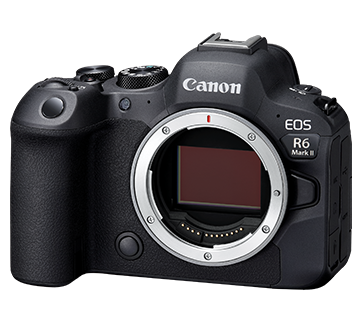
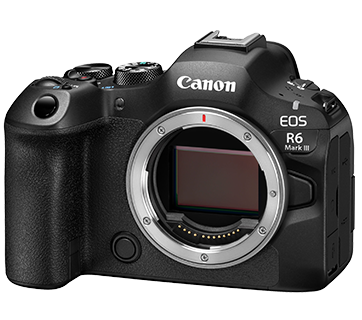
The Canon EOS R6 Mark II and EOS R6 Mark III are two highly regarded mirrorless cameras from Canon that share many similarities, making them popular choices among photographers and videographers. Both models target an audience that seeks a high-performance full-frame camera with a robust feature set suitable for a variety of applications, from wildlife photography to videography. As both cameras are closely related in the R-series range, potential buyers often find themselves choosing between these models due to minor but impactful differences in specifications and capabilities.
Specifications Comparison
Detailed Comparison
Image Quality
Both the Canon EOS R6 Mark II and Mark III feature a full-frame sensor which offers impressive image quality, delivering excellent details and color accuracy in a variety of lighting conditions. The megapixel count is identical at 24, ensuring that both cameras produce similarly high-quality images. The ISO range is also the same, extending from 100 to 102400, with both models able to reach up to 204800 for extreme low-light situations. However, the R6 Mark III has some enhancements in image processing that can provide slightly better dynamic range and color depth due to newer firmware and improved image algorithms, leading to marginally better performance in challenging lighting conditions.
Autofocus System
Autofocus performance is crucial for both still photography and videography. Both EOS R6 Mark II and Mark III share the same number of autofocus points at 4897, which allows for fast and reliable subject tracking. However, the autofocus system in the R6 Mark III has been refined and improved to handle subject recognition and tracking in a more sophisticated manner, especially for moving subjects. Users of the R6 Mark III will benefit from faster focusing speeds and more accurate tracking during high-speed shooting scenarios. While the R6 Mark II offers excellent performance, the advancements in the Mark III give it the edge, particularly for sports and wildlife photographers.
Video Capabilities
Both cameras support 4K video recording, but there is a significant difference in their capabilities. The EOS R6 Mark II is limited to 4K at 60 frames per second, while the R6 Mark III doubles that frame rate to 120 frames per second, offering greater flexibility for slow-motion recording. This higher frame rate makes the Mark III particularly appealing for videographers looking to create dynamic video content. Both models offer excellent 10-bit color depth and additional video features like Canon's Log, but the R6 Mark III ultimately stands out for those seeking advanced video functionalities.
Build & Ergonomics
Both cameras share the same dimensions and overall design, making them virtually identical in terms of ergonomics and handling. The weight difference is negligible, with the R6 Mark III being slightly heavier at 699g versus the R6 Mark II's 670g. Both models are robustly weather-sealed, providing confidence for outdoor photography in various environmental conditions. The buttons, dials, and touchscreen interface on both cameras are intuitive, catering to professionals who value quick adjustments and control. Given their similarities in build quality, this category results in a tie.
Battery & Storage
When it comes to battery performance, the Canon EOS R6 Mark II has a slightly better battery life with about 580 shots per charge, while the R6 Mark III is estimated to provide slightly less, though specific figures are not available yet. Both cameras use the same LP-E6NH battery, ensuring compatibility. In terms of storage, both models support dual card slots, allowing users to opt for a combination of CFexpress and SD UHS-II cards, which gives flexibility and redundancy for storage. That said, the R6 Mark II takes the nod for better battery life in real-world use.
Value for Money
In terms of pricing, the Canon EOS R6 Mark III is positioned at $2799, making it a higher investment compared to its predecessor. While the additional features and improved performance of the Mark III might justify the price hike for professional users, casual photographers might find the R6 Mark II to be a more financially sound choice. Given its excellent performance and slightly reduced price point, it stands out as a more attractive option for those seeking high-quality imaging without breaking the bank. Therefore, when considering value for money, the R6 Mark II holds an advantage.
Our Verdict
In the balance of the features assessed, the Canon EOS R6 Mark III ultimately shines as the superior camera, particularly for users requiring advanced video capabilities and enhanced autofocus performance. However, for those who prioritize value and can compromise on video features, the R6 Mark II remains a compelling option. Each camera excels in its own right, making the choice largely dependent upon the specific needs and budgets of the user, with the R6 Mark III being ideal for professional videographers and the R6 Mark II for photographers who seek excellence in stills.