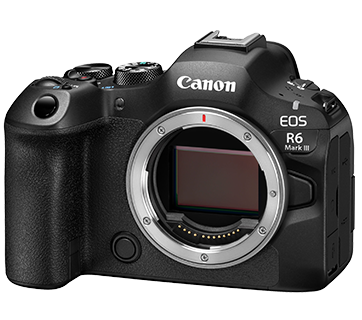
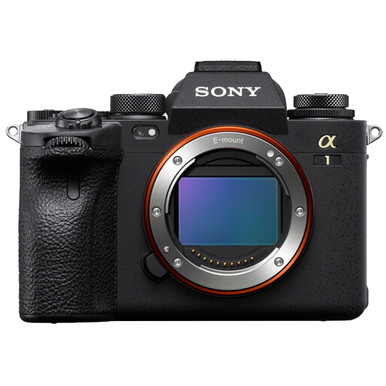
The Canon EOS R6 Mark III and the Sony A1 are two standout cameras in the full-frame mirrorless category, each appealing to professional photographers, content creators, and serious enthusiasts. While both models offer exceptional image quality and performance, they do so with different strengths and specifications that cater to various shooting styles. Photographers choosing between these two may be focusing on aspects like autofocus performance, video capabilities, and overall versatility for different scenarios-such as fast-paced action or high-resolution studio work. \n\nKey differentiators include the Canon's stronger stabilization and lower price point, while the Sony A1 offers a higher resolution sensor and a more powerful autofocus system. Understanding these elements will help potential buyers make an informed decision based on their specific photographic needs.
Specifications Comparison
Detailed Comparison
Image Quality
The Canon EOS R6 Mark III boasts a full-frame sensor size of 35.9 x 23.9 mm and delivers impressive performance with its robust ISO range of 100-102400, expandable to 204800. This versatility allows for stunning low-light performance and dynamic range suitable for a variety of shooting environments. In contrast, the Sony A1 features a slightly larger sensor size of 35.9 x 24 mm and a remarkable 50 megapixels. This resolution provides incredible detail preservation, particularly useful for landscape and fashion photography, where clarity is paramount. However, its ISO range runs from Auto 100-32000 but expands to only 50-102400.\n\nIn real-world scenarios, the Canon's high ISO capabilities may allow for cleaner images at extreme low-light conditions, while the Sony's higher resolution can introduce more detail during daylight shooting. Nonetheless, the differences in sensor performance may not be as glaring to the average user, depending on photographic intent and conditions. Ultimately, while resolution is essential, the versatility of the ISO performance in the Canon R6 Mark III makes a notable impact. \n\nIn conclusion, while both cameras deliver outstanding image quality, the R6 Mark III offers a more forgiving high-ISO performance, whereas the A1 excels in ultra-high resolution output. Therefore, this aspect may cater to different user needs.
Autofocus System
Focusing is a critical aspect where the Canon EOS R6 Mark III shines with its 4897 autofocus points, making it an exceptional choice for tracking fast subjects. This extensive coverage and versatility allows for quick and accurate subject capture during high-action events, ideal for sports and wildlife photography. Meanwhile, the Sony A1 features 759 autofocus points, also offering impressive tracking capabilities but with a slightly lower point coverage. However, it's worth noting that the A1 employs advanced AI-based algorithms enhancing its tracking abilities, especially for subjects with more intricate movement patterns. \n\nThe focusing systems of both cameras provide impressive performance for continuous shooting. The R6 Mark III supports up to 40 fps, giving it an edge in sheer speed, while the A1 supports 30 fps. As a photographer, the choice could also depend on specific autofocus functionalities like eye-detection capabilities or the speed of acquisition in low-light conditions, where Canon's system has received high praise. \n\nOverall, while both autofocus systems are stellar, the R6 Mark III's broader point coverage combined with its leading maximum frame rate gives it the edge in high-speed scenarios, while the Sony A1's intelligent tracking can be advantageous for more dynamic subjects.
Video Capabilities
Both the Canon EOS R6 Mark III and the Sony A1 support 4K video recording capabilities at 120 frames per second, providing filmmakers with high-quality, fluid footage suitable for various production styles. However, the R6 Mark III stands out with its 8.5 stops of in-body stabilization, allowing for smoother handheld video shooting-a notable advantage when shooting in dynamic environments. In contrast, the A1 offers 5.5 stops of stabilization but still provides good performance. \n\nAdditionally, it's important to consider the functionalities each camera brings to video performance. The R6 Mark III is known for its color science and skin tones, appealing to those who often shoot people or portraits. The A1 excels in higher resolutions and can shoot at 8K, providing more creative options for filmmakers needing to crop or stabilize in post-production.\n\nWhile both cameras provide remarkable video features, the Canon R6 Mark III may be favored for its superior stabilization and pleasing color representation, whereas the A1 appeals to those focused on maximum resolution and advanced video specifications.
Build & Ergonomics
Both the Canon EOS R6 Mark III and the Sony A1 are robustly built, with weather-sealed bodies designed to withstand tough shooting conditions. The Canon weighs slightly less at 699 grams compared to the Sony's 737 grams, which may offer a marginal advantage in portability for extended shoots. The dimensions of the R6 Mark III come in at 138 x 98 x 88 mm, while the A1 is slightly more compact at 129 x 97 x 81 mm, showcasing their designs aimed at balancing functionality with ease of use. \n\nMoreover, user interface design is another aspect where personal preference could come into play. Canon's menu system has long been praised for its intuitiveness and ease of use, whereas Sony's menu can be more complex and sometimes overwhelming. Adjusting settings on the fly is crucial during shoots, and this usability could influence overall efficiency. \n\nIn summary, both cameras are well-crafted for professional use; it may come down to personal preference for ergonomics and menu accessibility. For users prioritizing weight and user-friendly operation, the Canon may be the better fit.
Battery & Storage
Battery life and storage solutions can greatly impact a photographer's workflow, especially during long shoots. The Sony A1 boasts an impressive battery life with an estimated 530 shots per charge, compared to the Canon R6 Mark III, which does not specify an exact figure but is expected to provide similar performance. Nevertheless, users should note that this difference is slight enough that both cameras can generally meet the demands of daily use. \n\nIn terms of storage, both models support dual card slots, enabling JPEG and RAW recording on separate media. The R6 Mark III utilizes CFexpress Type B and SD UHS-II, allowing for high-speed data transfer; the A1 also has CFexpress Type A alongside SD UHS-II support. This ensures that high-resolution photos and 4K video can be captured without worry of data bottlenecking. \n\nUltimately, while minor differences exist in battery life and storage formats, both cameras provide reliable options for photographers without overwhelming limitations.
Value for Money
Price is often a pivotal consideration when choosing between the Canon EOS R6 Mark III and the Sony A1. Priced at $2799, the R6 Mark III offers a compelling value given its extensive feature set, particularly for those who emphasize video work and require effective stabilization. On the other hand, the Sony A1 comes in at $6500, representing a premium investment aligned with its higher resolution and advanced features geared towards professional users in high-end photography and commercial applications. \n\nHowever, potential buyers must evaluate whether the premium cost of the A1 corresponds with their specific needs, such as if they will truly benefit from high-resolution files, or if they require the rapid frame rates for action shooting. For many users, the feature set of the R6 Mark III provides a better balance of price to functionality, making it attractive for both enthusiasts and semi-professionals. \n\nIn conclusion, for the average photographer or videographer, the Canon EOS R6 Mark III stands out as a budget-friendly option with a strong performance ratio, while the A1 caters more directly to professionals requiring absolute precision and detail.
Our Verdict
Overall, the Canon EOS R6 Mark III emerges as the winner in this comparison, particularly for versatility, video capabilities, and value for money. Though the Sony A1 is undoubtedly a powerful camera, capable of impressive high-resolution work, the R6 Mark III addresses the needs of a broader range of users, especially those focused on action photography and videography. Ultimately, anyone looking for a reliable camera that balances performance with cost will find the Canon R6 Mark III to be an exceptional choice, while those needing ultra-high resolution and advanced functionalities might still consider the A1.