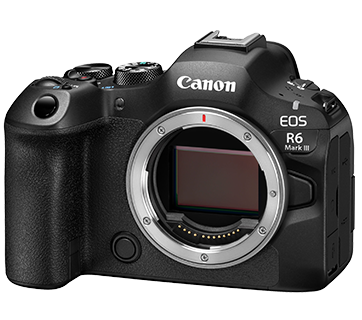

The Canon EOS R6 Mark III and the Sony A7S III are two flagship full-frame mirrorless cameras that are frequently compared by enthusiasts and professionals alike, particularly in the realms of photography and videography. Both models offer exceptional quality, advanced features, and robust performance, making them ideal contenders for users who require versatility in a range of shooting situations. Photographers may lean towards either camera based on their specific needs, such as low-light performance, autofocus capabilities, and video features, which both brands emphasize in their design philosophy.
Specifications Comparison
Detailed Comparison
Image Quality
The Canon EOS R6 Mark III features a larger overall ISO range, stretching from 100 to 102400, which can be expanded to 204800. This makes it particularly strong in low-light settings, capturing images with greater detail and less noise. Its sensor size is a standard full-frame (35.9 x 23.9 mm), and while specific megapixel counts were not provided, Canon typically emphasizes color depth and dynamic range. The R6 Mark III is designed for those who seek out highly detailed images, especially in challenging lighting conditions.
On the other hand, the Sony A7S III, though having only 12 megapixels, is renowned for its low-light performance capabilities. It features an ISO range from 80 to 102400, expandable to 409600. This expansion allows it to perform exceptionally well in very dim environments, which is a significant plus for videographers and photographers shooting in low-light or night conditions. Its sensor, while smaller in pixel count, compensates with pixel size and design aimed at maximizing light capture effectively.
Overall, while the R6 Mark III offers a higher megapixel count, the A7S III excels in low-light environments making image quality a nuanced discussion. Prospective users should consider their primary shooting conditions before deciding.
Based on overall versatility and low-light capability, the winner is the Canon EOS R6 Mark III.
Autofocus System
The Canon EOS R6 Mark III boasts an impressive 4897 autofocus points, allowing for highly accurate and versatile focus tracking across the frame. This extensive coverage is especially beneficial for dynamic shooting scenarios, such as sports or wildlife photography, where subjects may move unpredictably. Canon's Dual Pixel AF technology offers rapid focus acquisition and reliable performance in challenging lighting conditions, making the R6 Mark III a strong contender in autofocus performance.
In contrast, the Sony A7S III features 759 autofocus points, which, while fewer than the Canon counterpart, still offers exceptional tracking capabilities thanks to its Fast Hybrid AF system. The A7S III excels in real-time eye autofocus, making it ideal for capturing portraits and moving subjects. Users may find that the autofocus system in the A7S III can be just as reliable, particularly in portrait and video applications where eye detection is critical.
This section demonstrates that both cameras have outstanding autofocus systems, but the R6 Mark III has a more comprehensive point coverage that may appeal to users needing dynamic focus capabilities. Photographers largely relying on fast-paced subjects may lean towards the R6 Mark III.
In terms of autofocus system versatility and tracking performance, the Canon EOS R6 Mark III takes the lead.
Video Capabilities
Both the Canon EOS R6 Mark III and the Sony A7S III offer stunning 4K video capabilities at up to 120 frames per second, catering to the growing demand for high-speed and high-resolution video content. The R6 Mark III, however, shines with its enhanced in-body stabilization system, rated at 8.5 stops, which provides smoother handheld shooting-a major advantage for filmmakers working in dynamic environments.
The A7S III also supports resolutions up to 4K120p but features a 5.5 stop stabilization system, which may not be as effective during handheld movements compared to the R6 Mark III. Additionally, the A7S III has an advantage when it comes to its internal recording quality and dynamic range, allowing for more nuanced grading in post-production, making it a favorite among serious filmmakers.
For videographers needing robustness and simplicity in handheld shooting, the R6 Mark III provides a compelling advantage thanks to its superior stabilization. However, with its established video-centric features, the A7S III remains a powerhouse for high-quality production work.
Considering the need for stabilization and practical video recording, the winner is the Canon EOS R6 Mark III.
Build & Ergonomics
When assessing build quality and ergonomics, both cameras are designed to be tough and are weather-sealed, a critical factor for outdoor photographers. The R6 Mark III is slightly bulkier, with dimensions of 138 x 98 x 88 mm (5.43 x 3.86 x 3.46'') compared to the A7S III's 129 x 97 x 81 mm (5.08 x 3.82 x 3.19''). This weight and size difference can influence handling, particularly during prolonged shoots.
The Canon's larger grip may provide a more comfortable feel for users with larger hands, while the Sony's compact design can make it easier to handle for extended periods, particularly in more tight or mobile shooting contexts. Both cameras feature excellent electronic viewfinders providing clear images and responsiveness, enhancing the shooting experience.
Ultimately, user preference will play an important role in evaluating ergonomics. Canon may appeal to those who prioritize comfort during extended use, while Sony's lightweight design may suit those who prioritize portability.
Given the considerations regarding comfort and size, this aspect results in a tie.
Battery & Storage
The Canon EOS R6 Mark III has a significantly competitive battery life but does not specify shot count against the A7S III's remarkable 600-shot capability. Battery management can greatly impact workflow during shoots, particularly for wedding or event photographers. On the other hand, the A7S III benefits from dual card slots that allow for extensive storage options, supporting both CFexpress Type A and SD UHS-II cards that's critical for video shooting in high resolutions.
While the R6 Mark III has dual card slots as well, its reliance on SD media may limit speed compared to the advanced CFexpress standards present on the A7S III. This is particularly important for high-bit rate recording in video applications. The additional shot count from the A7S III's design leads to fewer interruptions, making it more favorable for long shooting sessions.
In this category, while both cameras hold strong capabilities, the Sony A7S III offers a more robust solution with its outstanding battery life and fast storage options. Thus, it wins this aspect.
Value for Money
Evaluating value, the Canon EOS R6 Mark III is priced at $2799, making it more affordable than the Sony A7S III at $3499. This price difference is significant and warrants consideration, especially for enthusiasts or professionals who are budgeting their investments in gear. Considering the features offered by the R6 Mark III enables photographers to take advantage of cutting-edge technology without straining their finances excessively.
However, the Sony A7S III, while pricier, offers incredible video capabilities that may justify the investment for dedicated filmmakers. The robust performance in low-light environments and superior internal recording options can appeal to users who prioritize these features above others.
Ultimately, for users with a mixed focus on both photography and videography, the R6 Mark III provides a better budget solution without sacrificing essential features, ensuring a more well-rounded experience for the price tag. For dedicated videographers, the A7S III's features may justify its higher cost despite the difference.
Considering the overall feature set against pricing structure, the Canon EOS R6 Mark III is declared the winner of this comparison.
Our Verdict
In conclusion, the Canon EOS R6 Mark III emerges as the overall winner owing to its superior performance across multiple aspects, especially in image quality, autofocus capabilities, and value for money. While the Sony A7S III offers strong video-centric features and low-light capabilities that may appeal specifically to filmmakers, the R6 Mark III strikes a better balance for users needing a versatile camera suited to hybrid shooting environments. The decision largely depends on individual preferences and intended use, but for most users, the R6 Mark III is more capable and offers impressive value.
Canon EOS R6 Mark III
Sony A7S III
Also Compare
Frequently Asked Questions
Which camera is better for low light photography?
The Sony A7S III excels in low-light situations due to its design and lower pixel count, which maximizes light capture, however, the Canon EOS R6 Mark III also offers a broad ISO range that enhances its performance in such conditions.
What is the main difference in video recording capabilities?
Both models offer 4K 120p recording, but the Canon EOS R6 Mark III has superior in-body stabilization, making it better for handheld video shooting compared to the A7S III.
Which camerahas better autofocus?
The Canon EOS R6 Mark III features a more extensive autofocus system with 4897 points, outpacing the A7S III's 759 points, making it more versatile for fast-moving subjects.
Is the battery life better on the Canon EOS R6 Mark III?
The Canon R6 Mark III's battery performance isn't specified, while the A7S III boasts a solid 600 shots per charge, giving it an edge in longevity for prolonged shooting.
Which camera is more ergonomic for prolonged use?
The Canon EOS R6 Mark III, being a bit bulkier, may offer a better grip for prolonged use, whereas the Sony A7S III is more compact, which may suit users looking for lighter gear.