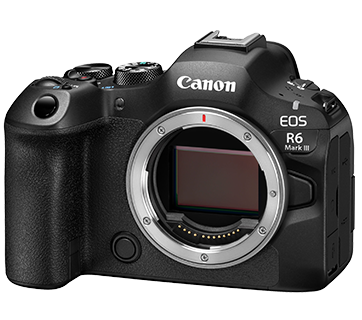
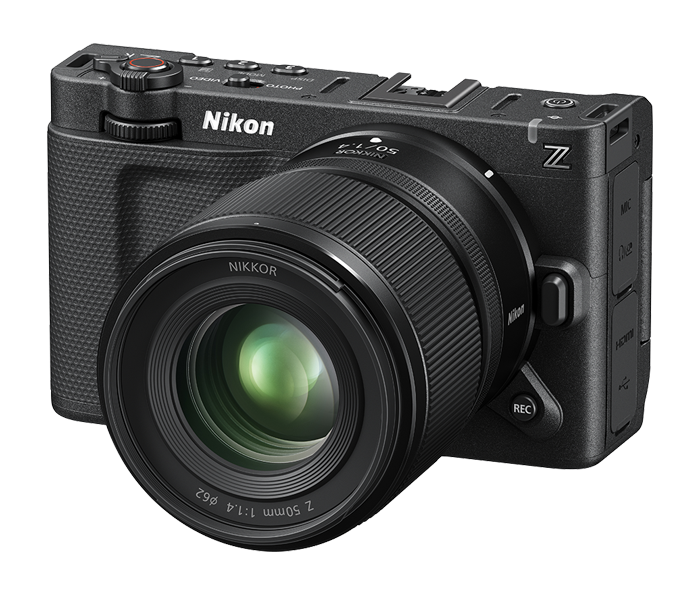
The Canon EOS R6 Mark III and Nikon ZR are both 2025 full-frame mirrorless cameras positioned to attract serious enthusiasts and professionals seeking a compact yet high-performance system. Their similar sensor sizes and weather-sealed bodies mean they often land on the same shortlist for photographers and hybrid content creators deciding on a new body or considering a switch to a different mirrorless platform.
While both deliver the image quality and versatility expected in their class, their designs reflect slightly different priorities. The Canon EOS R6 Mark III focuses on top-tier speed, video features, and advanced autofocus, whereas the Nikon ZR stands out for its portability and ultra-high-resolution touchscreen. Buyers will want to consider which system's strengths best fit their own creative needs and shooting style.
Specifications Comparison
Detailed Comparison
Image Quality
Both cameras use a full-frame sensor measuring 35.9 x 23.9 mm, delivering comparable baseline performance in terms of sensor size and depth-of-field control. While the Canon EOS R6 Mark III's megapixel count is not specified, the Nikon ZR offers 25 megapixels, providing ample detail for most standard applications like landscape, portrait, and event photography.
The R6 Mark III takes a clear lead in ISO range, offering native sensitivity up to 102,400 (expandable to an impressive 204,800) compared to the ZR's ceiling of 64,000. This means the Canon can produce cleaner images in challenging low-light settings, making it better suited for event and night photography.
Both cameras feature in-body stabilization, with the Canon rated at 8.5 stops and the Nikon at 7.5 stops-both exceptional, but Canon again pushes ahead. However, the higher-resolution screen of the ZR may make reviewing images more enjoyable, giving some real-world benefit during playback and focus checking.
For overall image quality-particularly in low light and stabilization-the Canon holds a noticeable advantage, though the Nikon's megapixel count ensures it delivers plenty of detail.
Autofocus System
Autofocus is an area where Canon has historically excelled, and the EOS R6 Mark III continues this trend with a staggering 4,897 autofocus points. This allows for more precise subject tracking, zonal AF options, and greater reliability when capturing fast action or unpredictable subjects. Canon's advanced AF system also typically benefits from more frequent firmware updates and deeper AI subject recognition.
The Nikon ZR, by contrast, offers 273 autofocus points-a solid figure, but one that can't match the granularity and coverage of the Canon. For general, static, and moderate action subjects, the ZR's autofocus is reliable. However, sports, wildlife, or challenging movement are better served by Canon's more sophisticated AF infrastructure.
Those who need the most robust, accurate, and flexible autofocus will find the Canon EOS R6 Mark III a clear winner here.
Video Capabilities
Video shooters will find considerable differences between the two models. The Canon EOS R6 Mark III offers outstanding video specs, supporting 4K recording at up to 120p. This enables high-quality slow-motion footage without cropping, a key feature for creative work, commercial production, and social media content that often relies on dynamic visuals.
The Nikon ZR's video capabilities are not detailed in the provided specs, so the Canon's high frame-rate 4K recording clearly stands out. Moreover, the Canon's industry-leading stabilization is particularly beneficial for handheld video work, providing smoother footage even without a gimbal.
Given that the Nikon lacks any mention of advanced video features or frame rate options, the R6 Mark III easily wins for anyone with serious video ambitions.
Build & Ergonomics
Both cameras feature full weather sealing, making them reliable in inclement conditions or demanding environments. The Canon EOS R6 Mark III has a slightly larger and heavier body (699g, 138 x 98 x 88 mm) compared to the Nikon ZR's more compact and lightweight design (630g, 133 x 81 x 49 mm).
A key difference is the Nikon ZR's absence of a viewfinder, which may be a significant drawback for those used to composing images through an EVF, particularly in bright outdoor conditions or for precise manual focusing. On the other hand, the ZR sports a much larger and higher-resolution rear screen-4 inches, 3,070,000 dots, versus Canon's 3-inch, 1,620,000-dot display.
Those who prioritize compactness and a brilliant rear screen may prefer the Nikon; however, the lack of any viewfinder makes it less suitable for fast-paced or traditional photography scenarios. Canon's more conventional design and inclusion of an EVF will suit a wider range of photographers.
Battery & Storage
Specific battery life and storage slot specs are not provided for either camera, making a direct technical comparison difficult. However, both fall in the same modern mirrorless class and likely utilize similar battery technology, with Canon's RF system usually providing good endurance and Nikon's Z-line known for efficient power use.
Storage-wise, both are assumed to offer at least one SD card slot and potentially support for UHS-II, but without explicit details, neither camera can claim a documented edge here.
With no clear advantage for either brand based on available data, this aspect is considered a tie.
Value for Money
Price plays a central role for many buyers. The Canon EOS R6 Mark III is priced at $2,799 USD, while the Nikon ZR offers much of the full-frame experience at $2,200 USD-a substantial $599 difference. Both offer weather sealing and in-body stabilization, but Canon delivers higher speed, stronger stabilization, more advanced autofocus, and far superior video features.
However, Nikon appeals to those who want a lighter, sleeker body, and may not need a viewfinder, advanced AF, or pro-grade video. The larger, higher-res screen could be a big plus for certain photographers (e.g., those frequently reviewing or sharing images via the back display). For those who don't need the Canon's cutting-edge performance, the ZR is a compelling, more affordable option.
Overall, although the Canon is more expensive, its feature set justifies the price for users who will benefit from its advanced capabilities.
Lens Ecosystem
The Canon EOS R6 Mark III uses the Canon RF mount, which now has an extensive selection of native lenses from Canon as well as third-party support from brands like Sigma and Tamron. This ecosystem covers everything from budget-friendly primes to flagship professional zooms.
Nikon's Z mount, though newer, has grown rapidly in both first-party offerings and third-party options. The ZR can access a range of modern primes, zooms, and adapters for legacy F-mount glass, which can be an advantage for photographers transitioning from Nikon DSLRs.
Both mounts offer a rich lens selection, but Canon's RF system currently has greater breadth and depth overall. The practical impact of lens choice will depend on individual needs, but in 2025, Canon's lead is still apparent.
Our Verdict
The Canon EOS R6 Mark III emerges as the winner in this head-to-head, taking clear leads in image quality, autofocus performance, video capabilities, ergonomics, and ecosystem support. Its additional cost is justified by meaningful features that will appeal to advanced enthusiasts and professionals seeking fast action capture, low-light performance, and high-end video. That said, the Nikon ZR is a highly competitive offering at a lower price, excelling in portability and offering a remarkable rear display. Mobile-first shooters, those on a tighter budget, or those prioritizing camera size and screen quality may prefer the Nikon-especially if a viewfinder isn't necessary for their work. Ultimately, both cameras are strong modern full-frame options, with the Canon's all-round strength giving it the edge for most demanding users.
Canon EOS R6 Mark III
Nikon ZR
Also Compare
Frequently Asked Questions
Is the lack of a viewfinder on the Nikon ZR a major disadvantage?
For photographers who depend on a viewfinder for composition, focusing, or shooting in bright sunlight, the absence of a viewfinder in the Nikon ZR is a significant drawback. However, users who shoot exclusively with the rear screen (such as vloggers or some casual shooters) may not mind this omission and could benefit from the ZR's excellent high-resolution display.
How do the autofocus systems differ in real-world use?
Canon's vastly higher number of autofocus points (4,897 vs 273) and its advanced tracking makes the R6 Mark III significantly better for fast-moving subjects, sports, and wildlife. The Nikon ZR performs reliably for static and moderately paced subjects but may struggle with rapid AF tracking in challenging settings.
Which camera is better for video content creators?
The Canon EOS R6 Mark III is clearly superior for video work, offering 4K at up to 120p, advanced in-body stabilization, and more robust autofocus. The Nikon ZR's lack of specified advanced video features puts it at a disadvantage for demanding video creators.
Which system has a better selection of lenses and accessories?
Canon's RF mount system has a more mature and extensive native lens lineup, including access to high-speed primes, professional zooms, and third-party support. Nikon's Z-mount options have grown quickly, and F-mount adapters provide even more flexibility, but Canon still holds a broader selection overall.
Which camera offers better value for the money?
The Nikon ZR is considerably less expensive ($2,200 vs $2,799), making it a great choice for those who don't need a viewfinder or the latest autofocus/video features. However, the R6 Mark III delivers superior performance in critical areas. If those advanced features are necessary for your work, the higher price of the Canon is justified.
Is the size and weight difference significant in practical use?
The Nikon ZR is notably lighter and more compact, which could make a real difference for travel or street shooters who value portability. The Canon is bulkier and heavier, but still compact by full-frame standards and more ergonomic for longer sessions or use with larger lenses.