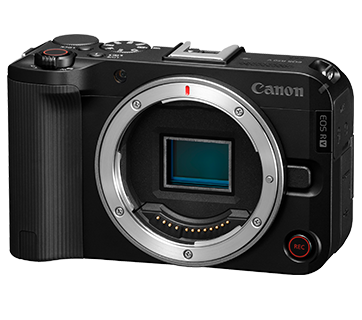

The Canon EOS R50 V and the Fujifilm X100VI are both highly appealing options for enthusiasts and casual shooters looking for excellent performance in a compact package, but they cater to somewhat different needs and philosophies. The R50 V represents Canon's entry-level APS-C mirrorless system, offering flexibility through interchangeable RF-S lenses, while the X100VI is a premium fixed-lens compact, revered for its classic design and advanced features. Buyers often find themselves comparing these two cameras when weighing flexibility versus premium build, or when seeking a balance between affordability and high-end image-making on the go.
The key differentiators center around lens options, build quality, sensor resolution, video features, stabilization, and price. The Canon R50 V is attractive for its lightweight design, lower cost, and option to change lenses, making it versatile for beginners or content creators on a budget. In contrast, the Fujifilm X100VI commands a significantly higher price but offers a higher resolution sensor, advanced hybrid viewfinder, robust mechanical stabilization, and a distinctive shooting experience ideal for travel, street, and documentary photographers seeking the best output in a portable form.
Specifications Comparison
Detailed Comparison
Image Quality
The Fujifilm X100VI stands out with its 40MP APS-C sensor, delivering higher resolution files compared to the Canon R50 V's 24MP sensor. This additional resolution benefits cropping, large prints, and fine-detail preservation, making the X100VI the superior choice for demanding image quality needs. The X100VI’s sensor is also slightly larger in physical dimensions, which can contribute to marginally improved dynamic range and noise control, especially at lower ISOs.
Further enhancing image quality, the X100VI boasts advanced film simulation modes and color science that are highly regarded among enthusiasts for their straight-out-of-camera JPEG rendering. The Canon R50 V, while very competent in image quality for its class, does not match the Fuji's output in detail or color profiles but still produces pleasing, accurate images that are perfectly suitable for most uses.
One significant difference is the X100VI’s built-in 6-stop image stabilization, allowing for sharper shots in low light without a tripod—something the R50 V lacks, as it only offers digital stabilization for video. Both cameras produce excellent images for their sensor size, but the X100VI comfortably edges ahead in overall image quality, flexibility in cropping, and low light support.
Autofocus System
The Fujifilm X100VI is equipped with an advanced autofocus system featuring 425 focus points and improved subject tracking, which provides speedy and accurate focus in a variety of scenarios, including face and eye detection. Its phase-detection system covers most of the frame, making it efficient for candid street photography and fast action.
The Canon EOS R50 V, while not having a quoted number of AF points here, leverages Canon’s Dual Pixel CMOS AF technology, known for its smooth, reliable autofocus for both stills and video. It performs well for tracking subjects, especially during vlogging or dynamic scenes, though it is typically optimized for simplicity and ease rather than high-end precision.
In practice, the X100VI offers more customizable AF modes and a denser array of points, which experienced shooters might prefer, especially for off-center compositions. However, the Canon’s system is very approachable for beginners and content creators, delivering consistent results. Overall, the X100VI has a technical edge thanks to its denser focus grid and wider coverage, but the real-world difference for average users may be modest.
Video Capabilities
The Canon EOS R50 V pulls ahead in the video department with 4K 60p recording, a high frame rate that enables smooth motion capture and slow-motion playback. Although it relies on digital stabilization, this is generally good enough for handheld vlogging or casual video work. Its fully articulating screen (3", 1,040,000 dots) is ideal for solo shooting and content creators.
The Fujifilm X100VI also supports 4K video, but typically at 30p or lower frame rates and with less emphasis on advanced video features. Its 6-stop in-body stabilization does provide a steadier image, but its fixed lens limits versatility for some shooting situations. The lack of a fully articulating screen may also hinder certain types of vlogs or creative compositions.
For users prioritizing high-quality, flexible video recording, especially fast-paced content, the Canon R50 V is the clear winner. Meanwhile, the X100VI remains more of a stills-oriented camera, with strong video features as a bonus.
Build & Ergonomics
The Fujifilm X100VI is built with a premium metal chassis, delivering a tactile, retro-inspired experience and a substantial feel at 521g. It incorporates both an optical and electronic hybrid viewfinder—a rare and highly praised feature among enthusiasts who value composing with the camera to their eye. The button layout and manual control dials reinforce its appeal to traditionalists and advanced users. Its screen is higher resolution (3”, 1,620,000 dots), providing a crisp interface for reviewing images.
By contrast, the Canon EOS R50 V is significantly lighter at 370g, and its more compact plastic body feels less robust but is easier to carry all day. Notably, the R50 V has no built-in viewfinder, relying solely on its rear screen for composition. The design is clean and approachable, oriented toward newcomers and those prioritizing portability, but lacks some of the tactile refinement and controls of the X100VI.
Overall, the X100VI offers a more premium build, advanced ergonomics, and a hybrid viewfinder experience, which gives it an advantage for serious photographers seeking a classic camera feel.
Battery & Storage
The Fujifilm X100VI provides an estimated 450 shots per charge, which is quite generous for a compact camera, especially with its high-powered sensor and bright display. Its battery life supports long outings without much concern about frequent recharging. Storage is via a single UHS-I SD card slot—a standard and reliable solution.
Canon does not specify battery life for the EOS R50 V here, but as an entry-level mirrorless model, it likely falls within the 300-350 shot range on a charge based on similar Canon bodies. Its lighter body and lack of viewfinder can sometimes help eke out more shots, though in practice, it tends to lag behind more premium models. Storage is also via a single SD card slot (not specified here but standard for this segment).
The edge goes to the X100VI for its superior battery stamina, which can make a meaningful difference when traveling or covering events.
Value for Money
The Canon EOS R50 V is aggressively priced at $649 USD, making it highly accessible for those entering interchangeable lens photography or seeking capable video features without a premium investment. It offers excellent performance per dollar, with the flexibility to change lenses and adapt the camera to many genres.
Conversely, the Fujifilm X100VI is priced at $1599 USD, a premium justified by its higher resolution sensor, in-body stabilization, hybrid viewfinder, premium materials, and unique fixed-lens experience. For users who want a luxurious, single-lens camera with no lens upgrade path needed, the X100VI delivers immense value, but at a high upfront cost.
For most buyers comparing these two, the value proposition of the R50 V is hard to beat, especially when considering versatility, lens options, and overall usability at less than half the price. The X100VI is unmatched within its niche, but doesn’t offer the all-around flexibility of the Canon system.
Lens Ecosystem & System Flexibility
One of the most significant differences between these two cameras is in lens versatility. The Canon EOS R50 V uses the Canon RF-S mount, granting access to an expanding lineup of native RF-S and RF lenses, as well as adaptors for older EF/EF-S glass. This translates to a flexible system you can grow with, suitable for everything from wide landscapes to intensive telephoto work—including specialty options like macro.
The Fujifilm X100VI, in contrast, features a high-quality 23mm f/2 fixed lens (equivalent to 35mm full-frame), offering exceptional optical quality but locking users into a single field of view. While there are conversion lenses available to slightly expand focal length options, they are limited in comparison to the broad creative possibilities of an interchangeable lens system.
If you prefer to experiment, specialize in genres that need diverse focal lengths, or want an upgrade path, the R50 V's system approach will serve you better. The X100VI’s lens is world-class, but system flexibility is firmly on Canon's side.
Our Verdict
Overall, the Fujifilm X100VI narrowly takes the lead thanks to its superior image quality, exceptional build, hybrid viewfinder, advanced autofocus, and in-body stabilization. It is an ideal tool for enthusiasts and professionals who desire an uncompromising, luxury experience in a street or travel photography context, and who can embrace its fixed-lens philosophy. However, the Canon EOS R50 V punches well above its weight for the price and shines in value, system flexibility, and advanced video features. It is arguably the best choice for beginners, hybrid shooters, or those seeking to experiment with different lenses and photographic genres without a steep investment. In summary: for the highest image quality, beautiful design, and a unique shooting experience go for the X100VI; for flexibility, video versatility, and budget-friendliness, the R50 V wins out. Choose based on your shooting style, preferred workflow, and long-term photographic goals.
Canon EOS R50 V
Fujifilm X100VI
Also Compare
Frequently Asked Questions
Can I change lenses on the Fujifilm X100VI?
No, the X100VI has a fixed, built-in 23mm f/2 lens (35mm equivalent). While Fuji offers wide and telephoto conversion lenses, you cannot use interchangeable lenses as you can with the Canon EOS R50 V.
Which camera is better for vlogging or YouTube?
The Canon EOS R50 V is better suited to vlogging thanks to its lightweight design, fully articulating screen, 4K 60p video, and interchangeable lenses. The Fujifilm X100VI, while capable, lacks a flip screen and has a fixed lens, making it less flexible for varied video scenarios.
Is the image quality of the X100VI significantly better than the R50 V?
Yes, primarily due to its higher 40MP resolution, larger sensor area, advanced film simulations, and in-body stabilization. This results in richer detail, better cropping flexibility, and improved low light shots compared to the R50 V’s still very capable 24MP sensor.
How important is having a viewfinder for everyday use?
A viewfinder can be essential for comfortable composition in bright conditions or for a traditional shooting experience. The X100VI offers both an optical and electronic viewfinder, giving it an edge over the R50 V, which only has a rear screen for composing shots.
Which is more portable?
The Canon R50 V is lighter (370g vs 521g) and physically smaller, especially with compact RF-S lenses. However, since the X100VI has a high-quality built-in lens, both are portable—choose based on whether you want ultimate lightness or a compact, all-in-one solution.
Is the higher price of the X100VI justified?
If you highly value premium build quality, a hybrid viewfinder, top-tier image quality, and a luxury user experience in a fixed-lens design, then yes. For photographers wanting more flexibility, lower price, and upgrade options, the R50 V is a smarter investment.