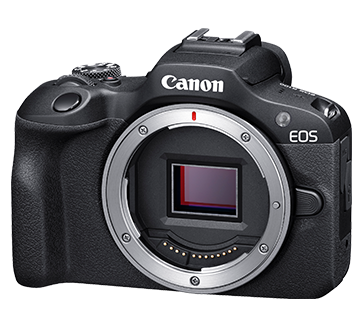

The Canon EOS R100 and Fujifilm X-S20 are two popular choices in the entry-level mirrorless camera segment, aimed at photographers seeking high-quality results without the steep price tags often associated with professional gear. Both cameras cater to amateur photographers and enthusiasts who prioritize portability and image quality but have different feature sets that might sway their decisions. The EOS R100 is positioned as a more budget-friendly option, while the X-S20 offers advanced features that appeal to those willing to invest more for enhanced capabilities.
Specifications Comparison
Detailed Comparison
Image Quality
The Canon EOS R100 features a 24-megapixel APS-C sensor, delivering excellent image quality that is typically sufficient for most photography needs. Its ISO range of 100-12800 allows for good low-light performance, making it versatile for various shooting conditions. However, without in-body stabilization, achieving sharp images in low-light scenarios can be challenging without the use of a tripod or stable surface.
In contrast, the Fujifilm X-S20 boasts a slightly higher 26-megapixel APS-C sensor and a wider ISO range, extending from 160-12800 and expandable up to 51200. This not only provides users with more options for low-light shooting but also tends to yield cleaner images at higher ISO settings. Additionally, Fujifilm's color science is well-regarded, offering vibrant and pleasing colors right out of the camera, which can appeal to photographers looking for distinct tonal qualities in their images.
While both cameras can produce beautiful pictures, the X-S20's higher resolution and more extensive ISO range provide an edge, especially in low-light situations. Thus, for image quality specifically, the Fujifilm X-S20 stands out as the better option.
Autofocus System
The autofocus system is a critical aspect of camera performance, particularly for moving subjects or fast-paced photography. The Canon EOS R100 comes equipped with 143 autofocus points, which provide a reasonable covering area for most shooting scenarios. While the system does support Dual Pixel technology for smooth transitions and tracking, its specifications may not hold up in more dynamic situations when compared to competitors.
On the other hand, the Fujifilm X-S20 includes a more advanced autofocus system with 425 points. This comprehensive coverage allows for improved tracking of moving subjects and a more precise focus, which is beneficial when shooting sports or wildlife. Moreover, the X-S20 employs face and eye detection that enhances portrait photography quality.
In this category, the Fujifilm X-S20's superior number of autofocus points and advanced technology for tracking make it the clear winner, offering a more capable system for varied shooting situations.
Video Capabilities
Video functionality is increasingly important for modern camera users. The Canon EOS R100 is limited to standard video recording capabilities, which are generally satisfactory for casual users. However, it lacks advanced features such as high frame rates and 4K video capture, making it less appealing for serious filmmakers or content creators.
Conversely, the Fujifilm X-S20 excels in this area with the capability to shoot 4K video at 60 frames per second. This high frame rate offers smoother motion and broader creative opportunities for videographers. Additionally, the X-S20 features various film simulation modes that enhance the aesthetic quality of video production, thus offering a comprehensive suite for content creators.
Given these capabilities, the Fujifilm X-S20 clearly surpasses the Canon EOS R100 in video features, making it a better choice for users focused on videography.
Build & Ergonomics
In terms of build quality, the Canon EOS R100 is compact and lightweight, weighing only 356 grams. Its dimensions make it very portable, which is ideal for travel and everyday carry. The 3-inch screen with 1,040,000 dots provides decent visibility for photo composing and reviewing, although it may lack some advanced functionalities found in competitors.
Meanwhile, the Fujifilm X-S20, although heavier at 491 grams and bigger in size, offers an ergonomically designed grip that many photographers find more comfortable during prolonged use. The X-S20's screen is slightly more advanced with a resolution of 1,840,000 dots, enhancing the user experience when composing shots. This camera also features additional physical dials for direct control over settings, appealing to those who prefer tactile feedback while shooting.
While both cameras have their merits, the Fujifilm X-S20's ergonomics and superior screen resolution give it the advantage in this category, albeit at the cost of increased weight.
Battery & Storage
Battery life is a vital consideration for anyone planning extended shooting sessions. The Canon EOS R100 has a fairly typical battery performance but does not provide specific ratings for shots. However, it is often presumed to yield fewer shots compared to its competitor due to its smaller design. This may necessitate carrying extra batteries for long shoots.
In comparison, the Fujifilm X-S20 claims a battery life of up to 750 shots per charge, making it more reliable for prolonged use without interruption. Additionally, it utilizes SD/SDHC/SDXC cards, allowing for ample storage capacity, while the Canon EOS R100 follows suit with similar card compatibility.
Overall, the Canon model may require more frequent battery changes during intensive sessions, whereas the X-S20 provides users with confidence in its extended performance, solidifying its status as the winner in this section.
Value for Money
When considering value for money, the Canon EOS R100, at a price point of $480, is an attractive option for those just starting out in photography or looking for an affordable yet capable camera. It offers solid image quality and a good overall feature set for the price, making it a tempting choice for amateur photographers or those needing a compact option for travel.
In contrast, the Fujifilm X-S20 is priced at $1,299, which might deter budget-conscious buyers. However, it delivers significantly more advanced features catering to serious photographers and videographers. The enhanced autofocus, superior video capabilities, and better build quality justify the higher price tag for many users looking for longevity in their investment.
Despite the Canon EOS R100's lower price reflecting good initial value, the additional features and capabilities of the Fujifilm X-S20 make it a stronger choice for those willing to spend more for greater versatility. Therefore, while the Canon offers excellent value for beginners, the X-S20 provides a more comprehensive solution in terms of capabilities and performance for dedicated users.
Our Verdict
Overall, while both the Canon EOS R100 and Fujifilm X-S20 have their strengths, the X-S20 emerges as the winner due to its superior image quality, autofocus capabilities, advanced video features, and robust battery life. In scenarios where portability and lower price are prioritized, the Canon EOS R100 offers an excellent entry point for beginners. However, for users who seek more advanced functionality and can justify the price difference, the Fujifilm X-S20 stands out as the more versatile option overall.
Canon EOS R100
Fujifilm X-S20
Also Compare
Frequently Asked Questions
Which camera is better for beginners?
The Canon EOS R100 is a more affordable option and is designed with ease of use in mind, making it an ideal choice for beginners just getting into photography.
Does the Fujifilm X-S20 have better video capabilities?
Yes, the Fujifilm X-S20 can shoot 4K video at 60p and offers advanced video features, making it a superior choice for those focused on videography.
Is the autofocus system good on both cameras?
Both cameras offer good autofocus systems, but the Fujifilm X-S20 has a much higher number of autofocus points and better tracking capabilities, making it more reliable for action shots.
Which camera has better battery life?
The Fujifilm X-S20 offers a significantly better battery life, rated at approximately 750 shots, compared to the Canon EOS R100, which has lower performance ratings.