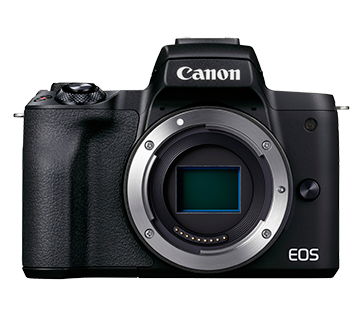

The Canon EOS M50 Mark II and Fujifilm X100VI are both popular choices among photography enthusiasts seeking high-quality, compact cameras, but they serve slightly different niches. The M50 Mark II, as an interchangeable lens mirrorless camera, is attractive to those wanting flexibility and a relatively approachable entry into large-sensor photography. In contrast, the X100VI is a premium fixed-lens camera, appealing especially to street, travel, and documentary photographers who value portability, classic styling, and a straightforward shooting experience without the need to swap lenses.
People often consider these two cameras when looking for high image quality and advanced features in a small body. Key differentiators include the X100VI's higher resolution, in-body image stabilization, and hybrid optical/electronic viewfinder, versus the M50 Mark II's fully articulated screen and lens-swapping abilities. Price, user experience, and intended use-case drive the decision between these two compelling options.
Specifications Comparison
Detailed Comparison
Image Quality
The Fujifilm X100VI boasts a new-generation 40MP APS-C sensor, giving it significant resolution advantages over the Canon EOS M50 Mark II's 24.1MP sensor. This allows for more detailed images and flexibility for cropping, which can be a major benefit for landscape, street, and fine art photographers. The X100VI sensor is also slightly larger (23.5 x 15.6 mm vs 22.3 x 14.9 mm), contributing to improved low-light performance and dynamic range, especially when paired with Fujifilm's renowned color science and film simulations.
The Canon M50 Mark II, while lower in resolution, still produces excellent image quality considering its price point and sensor size. The 24.1MP output is more than adequate for most enthusiasts and hobbyists, and the JPEG output has Canon's well-liked color profiles. It's worth noting that the M50 Mark II's sensor is less up-to-date in terms of readout speed and high ISO performance compared to what's found in the X100VI.
Further, the X100VI includes built-in 6-stop image stabilization for sharper handheld images, especially at slower shutter speeds, further enhancing its image quality potential in a variety of conditions-an edge over the unstabilized Canon EOS M50 Mark II.
In summary, while both cameras can produce great images, the X100VI takes a decisive lead in terms of resolution, stabilization, and overall sensor performance.
Autofocus System
The Fujifilm X100VI utilizes an advanced hybrid autofocus system with 425 selectable points, covering a wide portion of the frame. Its AF is fast, accurate, and particularly adept at face and eye detection, matching up to modern standards seen in Fujifilm's higher-end interchangeable lens bodies. The autofocus also performs robustly in lower light, lending itself well to snapshots and street photography.
The Canon EOS M50 Mark II features Canon's Dual Pixel CMOS AF, a technology widely praised for smoothness, especially in video and live view shooting. However, in practice, the M50 Mark II offers fewer AF points than the Fujifilm, and its subject detection algorithms are less sophisticated than those found in the X100VI-including eye and face tracking performance.
In fast action or challenging tracking scenarios, the X100VI pulls ahead, though the M50 Mark II still provides respectable AF speed and accuracy for its class. The Canon is particularly strong for vlogging or casual photography, where the subject is usually near the center of the frame.
Overall, while both have strong autofocus for their respective categories, the X100VI offers better coverage, more points, and superior tracking performance.
Video Capabilities
The Canon EOS M50 Mark II was designed with entry-level content creators in mind, offering 4K video (albeit with a significant crop) and very user-friendly features for vlogging, such as a fully articulated touchscreen and microphone input. The Dual Pixel AF makes focusing in video smooth and intuitive, though in 4K the camera reverts to contrast detection, which is less reliable.
The Fujifilm X100VI advances Fujifilm's video offerings with uncropped 4K recording up to 30p, and Full HD up to 240fps for slow-motion effects. It also surpasses the Canon with in-body image stabilization, which is useful for handheld video shooting. The autofocus system is also faster and more accurate during video recording, and the camera offers rich color profiles including film simulations. However, the X100VI lacks the fully articulating screen and some of the video-centric interface touches that make the M50 Mark II so appealing to vloggers.
If your primary use is vlogging or selfie-style videos, the Canon's fully articulated screen is a clear advantage. For cinematic video, handheld stabilization, and superior color, the X100VI is the stronger choice.
Overall, the X100VI edges ahead for pure performance and image quality in video, but the M50 Mark II remains a compelling option for solo creators focused on convenience.
Build & Ergonomics
The Fujifilm X100VI features a premium, compact body built with a blend of metal and high-quality plastics, giving it a solid feel and classic, retro-inspired design. It's slightly heavier (521g) and a bit more substantial in hand than the M50 Mark II, but gains are seen in weather resistance and tactile controls, including dedicated dials for aperture, shutter speed, and exposure compensation. The standout hybrid optical/electronic viewfinder offers a uniquely immersive shooting experience.
The Canon EOS M50 Mark II, in comparison, is notably more lightweight and compact, making it easier to carry for long periods. Its fully articulated touchscreen and simple, approachable layout make it extremely user-friendly, especially for those new to mirrorless cameras. However, the build feels more plasticky, and the control scheme is less customizable than that of the X100VI.
While users who prioritize classic handling and a robust build may prefer the X100VI, those looking for a lighter, more easily pocketable camera might favor the M50 Mark II. The X100VI's enhancements such as weather sealing and mechanical dials give it a premium edge, though the Canon still scores high for comfort and usability among beginners.
Given these considerations, the X100VI's build quality and controls make it the winner, though the Canon holds its own for those prioritizing outright portability.
Battery & Storage
The Fujifilm X100VI offers a CIPA-rated battery life of 450 shots per charge, which is competitive for a modern compact camera, and is sufficient for a full day of casual shooting if power management strategies are used. The camera uses a single SD card slot, as does the M50 Mark II.
The Canon EOS M50 Mark II, on the other hand, has a more modest CIPA battery rating of about 305 shots per charge. In real-world use, particularly with frequent use of the touchscreen and Wi-Fi, users may need to carry a spare battery for a full day's shooting. Both cameras use broadly available SD media, meaning storage does not tip the balance either way.
While neither is a leader in battery stamina, the X100VI offers tangible improvements in shot count and can be recharged over USB-C, adding extra convenience for travel.
Therefore, for extended outings or travel, the X100VI pulls ahead due to its higher battery capacity and more convenient charging.
Value for Money
Canon's EOS M50 Mark II is significantly more affordable than the X100VI, often available for less than half the price of Fujifilm's premium compact. For entry-level photographers or those making their first leap into large-sensor interchangeable lens systems, the M50 Mark II delivers an excellent price-to-performance ratio, featuring good image quality, a user-friendly interface, and the flexibility to change lenses.
Conversely, the Fujifilm X100VI demands a much higher price ($1599 USD), justified by its top-tier sensor, excellent optics, build quality, and unique feature set, like the hybrid viewfinder and built-in stabilization. Nonetheless, its fixed 23mm (35mm equivalent) lens may be limiting to some, especially when compared to the M50 Mark II's adaptability with various lenses. The X100VI, however, depreciates less and tends to retain its value well on the used market.
Ultimately, for budget-conscious creators or those seeking system flexibility, the M50 Mark II stands out as a value proposition. The X100VI is for buyers willing to invest in a refined, specialized photographic tool.
Given the differences in target market and price, in terms of value relative to investment and versatility, the Canon EOS M50 Mark II gets the edge.
Lens Ecosystem
One of the most significant practical differences is the M50 Mark II's compatibility with interchangeable lenses. The Canon EF-M mount, while not as extensive as Canon's EF or RF lines, still offers a reasonable selection of native lenses as well as compatibility with adapted Canon EF/EF-S lenses. This makes the M50 Mark II a more flexible tool for those wishing to experiment with different focal lengths and lens types.
The Fujifilm X100VI has a fixed, high-quality 23mm f/2 lens, equivalent to 35mm in full-frame terms-a versatile focal length for street, travel, and general-purpose photography. While conversion lenses are available, they are limited in variety, and overall this camera is less flexible if you need telephoto, macro, or ultra-wide perspectives.
For users valuing a single high-performance lens in a compact package, the X100VI excels, but those prioritizing creative versatility will benefit more from the M50 Mark II's wider lens selection.
Thus, the Canon EOS M50 Mark II is the winner for anyone who sees lens choice as a major factor.
Our Verdict
The Fujifilm X100VI secures the overall win in this comparison due to its state-of-the-art sensor, outstanding image quality, advanced autofocus, effective in-body stabilization, and superior build. It's a camera designed for enthusiasts and professionals looking for the best possible performance in a classic, highly portable body-especially if the 35mm-equivalent focal length suits your shooting style. However, the Canon EOS M50 Mark II remains an excellent and extremely accessible camera. It is the better value-for-money option, especially for beginners or those wanting lens versatility, and is uniquely suited for vlogging thanks to its articulated touchscreen. Choose the M50 Mark II if you prioritize affordability and flexibility, or the X100VI if you desire a polished, premium experience and top-tier stills performance in a fixed-lens compact.
Canon EOS M50 Mark II
Fujifilm X100VI
Also Compare
Frequently Asked Questions
Which camera is better for beginners?
The Canon EOS M50 Mark II is generally better for beginners due to its user-friendly interface, lower price, and fully articulated touchscreen. It makes learning easier and offers flexibility with interchangeable lenses as you grow your skills.
Can I change lenses on the Fujifilm X100VI?
No, the X100VI has a fixed 23mm f/2 lens (35mm equivalent field of view). While you can add conversion lenses for slightly wider or more telephoto perspectives, the system is not interchangeable like the M50 Mark II.
Which camera is better for video, especially vlogging?
The Canon EOS M50 Mark II is better suited for vlogging and self-recording thanks to its fully articulating screen and microphone input. The X100VI offers higher video image quality and stabilization, but its screen does not flip forward for easy self-monitoring.
Is the Fujifilm X100VI worth the higher price?
The X100VI justifies its price with exceptional build quality, a high-res sensor, advanced autofocus, in-body stabilization, and unique features like the hybrid viewfinder. If you'll benefit from these and are comfortable with a fixed focal length, it's worth the investment.
Which camera is more portable?
Both are compact by large-sensor camera standards, but the X100VI is slightly heavier and bulkier due to its premium materials and features. However, since it doesn't require additional lenses, it can be more convenient for travel or everyday carry.
Can I use the Canon EOS M50 Mark II for professional work?
While it lacks some advanced features found on higher-end cameras, the M50 Mark II can certainly be used for professional imaging in controlled environments, especially with good lenses. Its limitations are more apparent in low-light, high-action, or demanding video scenarios.