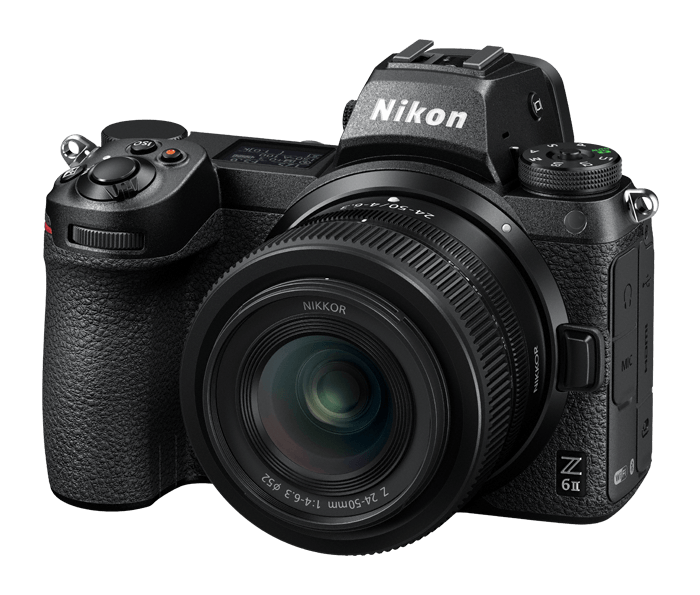

The Nikon Z6 II and Sony A9 III are two top-tier full-frame mirrorless cameras that photographers and videographers often consider when upgrading or investing in new camera systems. Both models are designed for professionals but cater to different use cases. The Z6 II focuses on a balanced performance for both stills and videos, while the A9 III is engineered primarily for speed and high-performance shooting, particularly in sports and wildlife photography. This comparison will highlight their key differences, helping potential buyers decide which camera better suits their needs.
Specifications Comparison
Detailed Comparison
Image Quality
Both the Nikon Z6 II and Sony A9 III feature full-frame sensors with 25 megapixels that deliver excellent image quality, producing detailed and vibrant images. The Z6 II's ISO range extends from 100 to 51,200, expanding further to 50-204,800, which allows for greater versatility in low-light environments. On the other hand, the A9 III, while not having the same low-light capability in terms of its ISO, offers impressive dynamic range and color accuracy. Both cameras benefit from advanced image processing capabilities, which enhance their color reproduction and low-light performance. Despite this, many testers note that the Nikon Z6 II provides a slightly warmer and more filmic look, which some photographers prefer for portraits and landscapes.
Autofocus System
The autofocus systems in both cameras are robust, but they serve different purposes. The Nikon Z6 II features 273 autofocus points, offering good coverage, particularly useful for still photography and some video work. However, the Sony A9 III takes autofocus to another level with its remarkably fast and accurate 693 point phase detection system, which excels in tracking moving subjects at high speed. This capability is particularly beneficial for sports and wildlife photographers, as the A9 III can shoot at an impressive 120 frames per second (fps) in continuous shooting mode, allowing for capturing quick movements with precision. Nikon's focus system is certainly competitive, but the A9 III's advanced technology makes it the clear winner for fast-paced scenarios.
Video Capabilities
When it comes to video, the Sony A9 III truly stands out with its ability to shoot 4K at 120p, catering to videographers seeking high frame rates for slow-motion applications. Although the Nikon Z6 II is a solid option for videography with its 4K 30p capabilities, it falls short in comparison to the A9 III, especially for those who prioritize high-resolution video. Additionally, the A9 III offers superior video features such as S-Cinetone color science and excellent heat dissipation, allowing for longer recording times without overheating. In contrast, the Z6 II provides solid video support but lacks the frame rate versatility found in the A9 III.
Build & Ergonomics
Both cameras feature high-quality construction, but there are notable differences in ergonomics. The Nikon Z6 II weighs 705 grams, making it slightly heavier than the Sony A9 III at 617 grams. This difference may become significant during extended shoots. The Z6 II also has weather sealing, making it well-suited for outdoor use in various conditions. Conversely, the A9 III, which has a more robust design, includes several additional features catering to professional needs, such as an adjustable viewfinder and a more intuitive layout for quick access to commonly used settings. Both cameras are well-built, but the choice may come down to personal preference in terms of balance and handling in hand.
Battery & Storage
The Nikon Z6 II boasts a battery life of approximately 410 shots per charge, which is commendable for a mirrorless camera. However, the Sony A9 III enhances the shooting experience with a higher battery capacity, allowing for longer shooting sessions - its battery performance is among the best for mirrorless systems, although specific shot counts may vary depending on usage. Both cameras utilize compatible memory storage options (XQD/CFexpress for the Z6 II and dual CFexpress Type A for the A9 III), but the A9 III's dual slots provide an advantage in storage and redundancy during professional workflows. This factor can be critical for photographers and videographers who need peace of mind regarding data safety during shoots.
Value for Money
At the price point of $1995 for the Nikon Z6 II, it provides a solid balance of features and image quality, particularly for amateur to semi-professional photographers who may not need the rapid-fire performance of the A9 III. However, the A9 III, priced significantly higher, justifies its cost with advanced features, superior autofocus, exceptional video capabilities, and overall performance. For professionals, the A9 III presents a strong case for its price due to its speed and technology, especially if these are critical for their work. For hobbyists or those on a tighter budget, the Z6 II represents a more attainable yet powerful option.
Our Verdict
In summary, the Nikon Z6 II and Sony A9 III each have distinct strengths that cater to different types of photographers and videographers. The Z6 II excels in providing a well-rounded experience that appeals to a broader audience, particularly at a more accessible price, while the A9 III offers unmatched speed and advanced features for professionals in high-action environments. The ideal choice ultimately hinges on your specific requirements, whether that be all-around performance or cutting-edge capabilities.