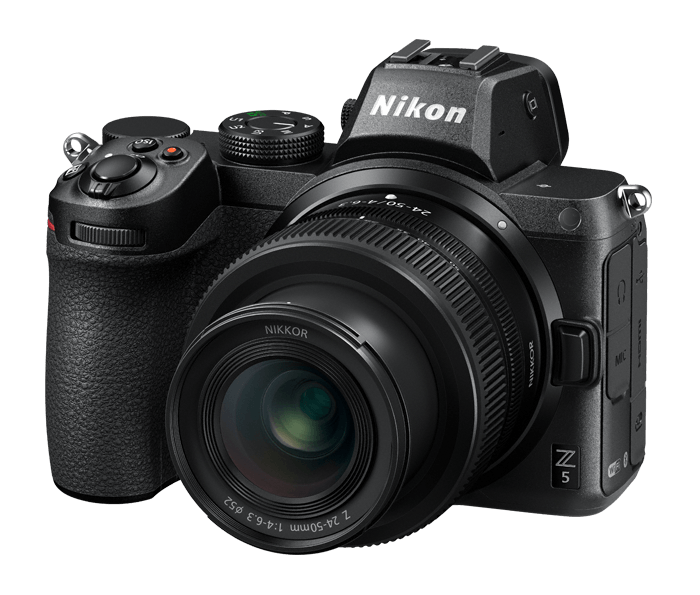
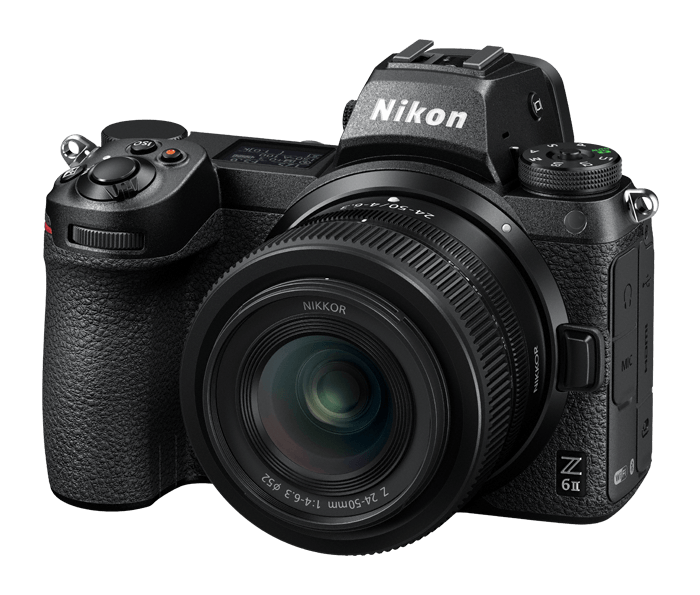
The Nikon Z5 and Nikon Z6 II are two prominent entries in Nikon's mirrorless camera lineup, aimed at both amateur and professional photographers. The Z5, often considered an entry-level full-frame camera, showcases a well-rounded feature set that appeals to enthusiasts and those upgrading from APS-C formats. The Z6 II, on the other hand, is positioned as a more advanced model with superior specifications, making it attractive to professionals seeking additional functionalities. With both models sharing a similar design and full-frame sensor size, potential buyers frequently find themselves evaluating which camera best fits their needs based on performance and budget. Key differentiators include autofocus capabilities, frame rate, and overall feature robustness, which can significantly impact a photographer's shooting experience depending on their requirements.
Specifications Comparison
Detailed Comparison
Image Quality
Both the Nikon Z5 and Z6 II utilize a full-frame sensor measuring 35.9 x 23.9 mm, which is fundamental for producing vibrant images with impressive detail and dynamic range. The Z5 offers 24 megapixels, while the Z6 II has a marginally higher 25 megapixels. However, the real advantage comes from the Z6 II's higher ISO capabilities, expanding up to 204800 compared to the Z5's limit of 102400. This higher ceiling allows for better performance in low-light conditions. Furthermore, users of the Z6 II can expect slightly improved color depth and tonal variance during post-processing because of its higher pixel count. In real-world applications, both cameras perform excellently, but the Z6 II is better suited for situations requiring extensive cropping or low-light conditions. Overall, the Z6 II has a slight edge in image quality due to its extended ISO range and higher megapixel count.
Autofocus System
Both models share a robust autofocus system featuring 273 focus points. However, the Z6 II enhances its autofocus performance with dual processors, leading to quicker subject tracking and more reliable performance in challenging shooting scenarios, such as fast-moving subjects in sports or wildlife photography. The Z5, while competent, can struggle slightly more with maintaining focus in these scenarios due to its single processor. Many users have reported that the Z6 II's ability to lock onto moving subjects without hunting is notably superior. The Z5, on the other hand, provides sufficient autofocus capabilities for general photography. In considering the overall effectiveness for professional work, the Z6 II's evolution of the autofocus system makes it the preferred choice for those who prioritize speed and accuracy.
Video Capabilities
Both the Nikon Z5 and Z6 II offer 4K video recording at 30p, allowing for high-quality video production. However, the Z6 II incorporates additional features such as a smoother high frame rate recording option, enabling 1080p video up to 120fps, which is beneficial for slow-motion shots. The Z5 does not support this, limiting its video flexibility. Additionally, the Z6 II's dual card slots provide a significant advantage for video recordings, allowing for simultaneous recording to provide redundancy or separating high-resolution videos from lower-quality proxies. For videographers seeking a more comprehensive range of video functions and adaptive recording options, the Z6 II becomes the clear choice.
Build & Ergonomics
Both cameras feature outstanding build quality and ergonomics, designed for comfortable handling during extended shoots. They are weather-sealed, providing durability against the elements, which is essential for outdoor photographers. The dimensions are identical at 134 x 101 x 70 mm, but there's a slight difference in weight; the Z5 is lighter at 675g, whereas the Z6 II weighs 705g. While the weight difference is negligible, it may contribute to the overall feel during extensive use. Both models include a fully articulating touchscreen, although the Z6 II offers a higher resolution at 2,100,000 dots compared to the Z5's 1,040,000 dots, enhancing the overall user experience. Thus, while both cameras are well-built, the Z6 II edges ahead due to the superior screen quality and slightly more robust internal components.
Battery & Storage
The Nikon Z5 boasts a higher battery life of approximately 470 shots versus the Z6 II's rating of 410 shots, which can be advantageous during long shooting sessions without access to charging. However, the Z6 II supports dual memory card slots, allowing for more expansive storage options and improved workflow efficiency-particularly for photographers needing to store high-resolution photos or videos quickly. The ability to save on one card while using the other as a backup or for raw JPEG separation can be crucial for professionals. Therefore, while the Z5 is better regarding single battery life, the storage versatility of the Z6 II makes it more adaptable for varied shooting environments.
Value for Money
The Nikon Z5 is priced at $1399, making it an appealing choice for budget-conscious photographers seeking a full-frame experience without breaking the bank. Conversely, the Z6 II is priced at $1995, reflecting its enhanced capabilities and performance that cater to professionals. When considering features like improved autofocus, video capabilities, and overall image quality, the Z6 II offers solid value for those who need its advanced features. However, for entry-level users or hobbyists who do not require the full range of advanced functionalities, the Z5 emerges as a sensible choice for its affordability without sacrificing essential quality. Hence, the decision largely depends on the specific needs and budget of the buyer.
Our Verdict
Overall, the Nikon Z6 II outshines the Nikon Z5 in critical areas including autofocus performance, video capabilities, and screen quality, making it ideal for professional applications, especially sports and videography. While the Z5 offers excellent value for beginners and light enthusiasts with its longer battery life and lower price point, photographers looking for advanced performance should favor the Z6 II for its superior specifications and adaptability to professional environments. Buyers should assess their individual needs and how they plan to utilize the camera to make an informed decision.
Nikon Z5
Nikon Z6 II
Also Compare
Frequently Asked Questions
Which camera is better for beginners?
The Nikon Z5 is often recommended for beginners due to its lower price, excellent image quality, and user-friendly controls, making it easier to learn without being overwhelmed by advanced features.
How does low-light performance compare?
The Nikon Z6 II excels in low-light performance due to its higher maximum ISO range of 204800 compared to the Z5's 102400, allowing for clearer images in darker conditions.
Is the Z6 II worth the extra cost?
If you frequently shoot fast-moving subjects or require professional-grade video features, the additional cost of the Z6 II could be justified by its superior autofocus, better video capabilities, and dual card slots.
Can both cameras utilize existing Nikon lenses?
Yes, both the Z5 and Z6 II can use Nikon Z-mount lenses, but the use of an FTZ adaptor also allows compatibility with a wide range of F-mount lenses.
What are recommended accessories for each model?
Essential accessories for both models include an extra battery, a sturdy camera bag, and a fast lens for low-light scenarios. For the Z6 II, consider acquiring high-speed memory cards to fully utilize its video and burst shooting capabilities.