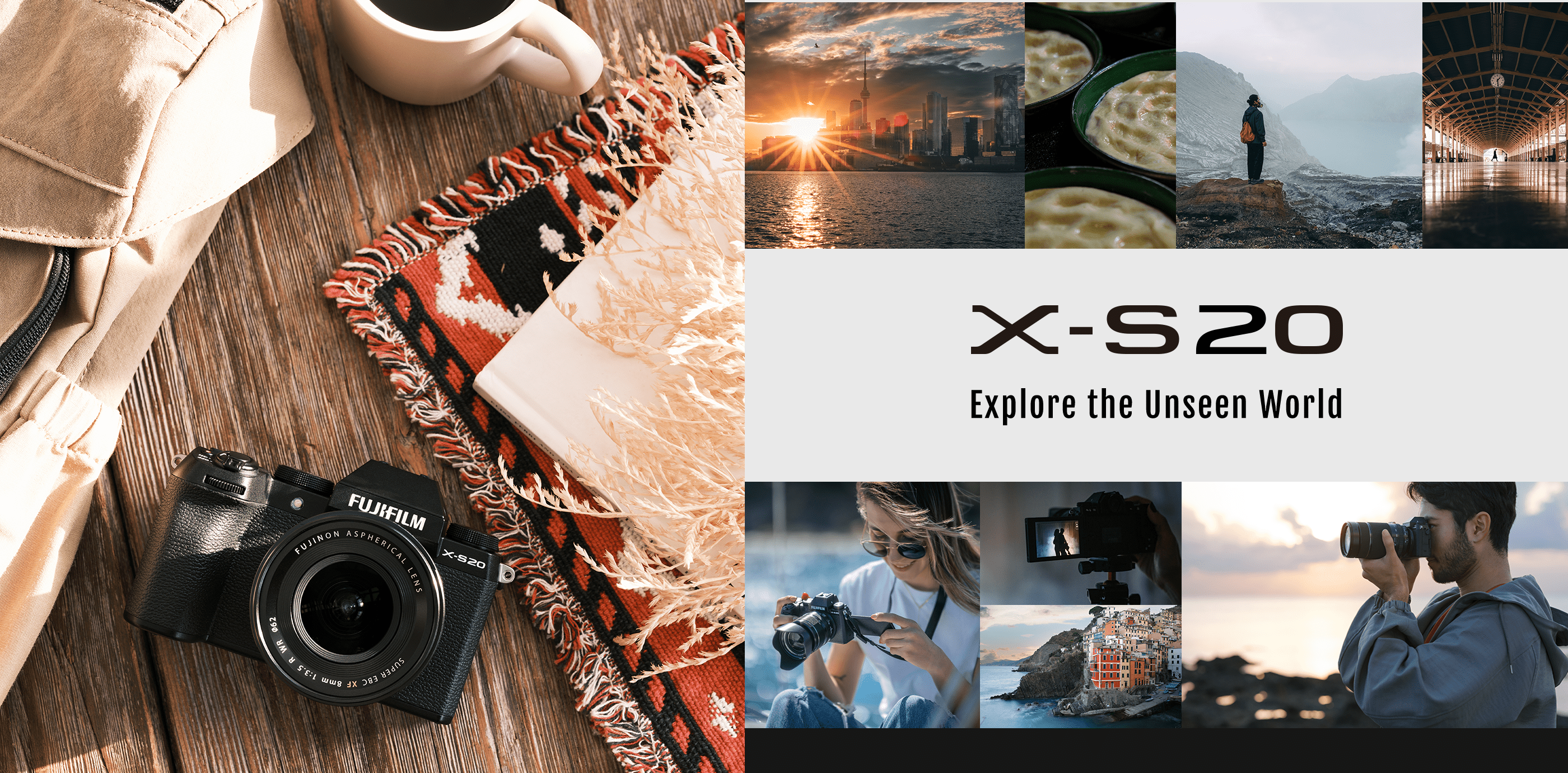

The Fujifilm X-S20 and the Sony ZV-E10 II are two compelling mirrorless cameras that attract photographers and videographers alike, primarily due to their APS-C sensors, impressive resolutions, and user-friendly interfaces. The X-S20 is often favored by enthusiasts seeking advanced photographic capabilities, while the ZV-E10 II appeals to vloggers and content creators looking for a portable yet powerful option. As both cameras come with similar price points and specifications, the decision often hinges on individual performance preferences and use-case scenarios.
Specifications Comparison
Detailed Comparison
Image Quality
Both the Fujifilm X-S20 and the Sony ZV-E10 II feature APS-C sensors with a resolution of 26 megapixels, ensuring excellent image quality and detail. The X-S20 utilizes Fujifilm's renowned film simulation modes, which allow users to achieve a unique aesthetic straight out of the camera, making it particularly appealing for creative photographers. Its ISO performance is commendable, ranging from 160 to 12800 (expandable to 80-51200), making it versatile in various lighting conditions. In contrast, the ZV-E10 II has a slightly broader ISO range of 100-32000 (expandable to 50-102400), which may provide some flexibility in extremely low light scenarios. However, the overall image quality during high ISO performance might not stack up to the X-S20's capabilities, thanks to its superior noise control.
Autofocus System
The autofocus systems in these cameras are one of the most significant differentiators. The Fujifilm X-S20 boasts 425 autofocus points, offering fast and reliable focus in a variety of shooting conditions. Conversely, the Sony ZV-E10 II is equipped with 759 autofocus points, which is significantly more and supports faster subject tracking, an essential feature for capturing fast-moving subjects or during video recording. This advanced system provides more precise focusing, especially in complex scenes. For users primarily focused on video work or capturing action shots, the ZV-E10 II's autofocus capabilities may provide an edge, while the X-S20 remains very competitive for general photography tasks.
Video Capabilities
Both the Fujifilm X-S20 and the Sony ZV-E10 II are capable of shooting 4K at 60p, catering to content creators looking to produce high-quality video. However, the X-S20 stands out with additional features like advanced in-body stabilization rated at 7 stops, which can tremendously enhance handheld shooting smoothness. This is a critical advantage for those who film without a tripod or gimbal. On the other hand, while the ZV-E10 II does not offer built-in stabilization, its video features are geared towards vlogging, including a vari-angle touchscreen and optimized audio recording capabilities. Although both cameras perform strongly in this area, the stabilization of the X-S20 gives it a noteworthy advantage for diverse video applications.
Build & Ergonomics
When considering build quality and ergonomics, both cameras offer distinct advantages. The Fujifilm X-S20 has a compact design but offers an electronic viewfinder, which can greatly assist in composing shots in bright conditions. It has a sturdy build but is not weather-sealed, making it less suitable for extreme environments. In contrast, the Sony ZV-E10 II is notably lighter at 377 grams and designed specifically with content creation in mind, lacking a viewfinder but featuring a fully articulating touchscreen that allows for easy composition whether on a tripod or handheld. The ZV-E10 II's weather-sealing is a plus for outdoor enthusiasts, potentially giving it more resilience when shooting in challenging conditions. Overall, for traditional photography, the X-S20 might feel more robust, while the ZV-E10 II suits vloggers and casual shooters.
Battery & Storage
In terms of battery performance, the Fujifilm X-S20 excels with a battery life rated for approximately 750 shots per charge, making it more suitable for long shooting sessions or extended events. The ZV-E10 II, while lighter and portable, has a lower battery life due to its smaller form factor, which can be a significant drawback for those planning longer video recordings. Furthermore, both cameras utilize SD card storage systems; however, the Fujifilm X-S20 supports UHS-II cards, allowing for faster data transfer rates during high-resolution video recordings. The ZV-E10 II is compatible with UHS-I cards, which can affect performance during burst shooting or 4K video capturing under heavy use.
Value for Money
The Fujifilm X-S20 is priced at $1299, while the Sony ZV-E10 II is available for $1000, making the latter more budget-friendly for entry-level users. With its price point, the ZV-E10 II offers great value, particularly for vloggers who benefit from its lightweight design and videography features. However, considering the features offered by the X-S20, particularly in stabilization, image quality, and build, users may find the extra investment worthwhile if they prioritize photography alongside video. Potential buyers should assess their primary use cases; those focused solely on video may find the ZV-E10 II offers more bang for the buck, while those looking for a more versatile tool may lean towards the X-S20.
Our Verdict
Ultimately, the Fujifilm X-S20 takes the crown as the overall winner due to its superior image quality, stabilization features for video recording, and robust battery life, making it an excellent choice for hybrid photographers and videographers. However, the Sony ZV-E10 II cannot be dismissed, especially for vloggers or content creators on a budget, as its lighter build and advanced autofocus system cater perfectly to on-the-go shooting. In deciding between these two excellent options, buyers must consider their primary needs-whether they prioritize still photography with the occasional video or thrive in a videography-heavy environment. Both cameras excel in their respective realms, ensuring users can find a fitting choice within their specific use cases.