
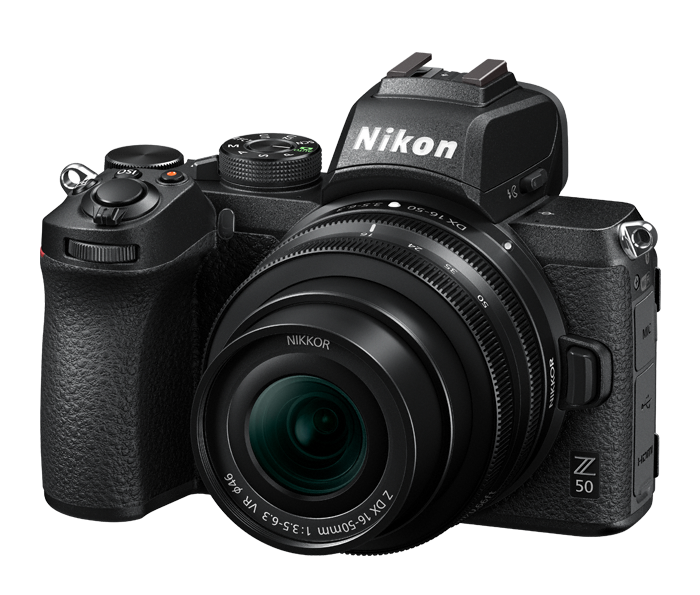
The Fujifilm X-S20 and Nikon Z50 are two popular choices in the APS-C mirrorless camera market, often compared by enthusiasts and professionals alike who are looking for a compact yet versatile camera system. Both cameras are aimed at creators who want great image quality and performance without delving into larger full-frame models. The X-S20 is newer, featuring advanced specifications that cater to modern needs, while the Z50, released in 2019, offers a solid feature set that has proven itself over time. Key differentiators between the two include sensor performance, autofocus strength, and video capabilities.
Specifications Comparison
Detailed Comparison
Image Quality
The Fujifilm X-S20 boasts a 26-megapixel APS-C sensor compared to the Nikon Z50's 21-megapixel sensor. This higher resolution in the X-S20 translates to more detailed images, which can be crucial for large prints or heavy cropping. Additionally, the X-S20 has a wider ISO range starting from 160 up to 51200, while the Z50 starts from 100 and can go up to 204800. This gives the X-S20 an edge in low-light situations, providing better image quality with less noise at higher ISO values. Meanwhile, the Z50 may perform well at its upper limit but will likely show more noise in comparable situations.
Autofocus System
The autofocus system in the X-S20 is significantly more advanced, featuring 425 focus points compared to the Z50's 209. This extensive coverage allows for quicker and more accurate focus acquisition across the frame, which is especially beneficial for capturing fast-moving subjects. Fujifilm's hybrid autofocus also benefits from phase detection pixels, streamlining focus in different lighting conditions. Conversely, while the Z50's autofocus is competent for general use and performs adequately for casual photography and videography, it lacks the advanced tracking capabilities and overall speed of the X-S20's system.
Video Capabilities
When it comes to video recording, the X-S20 clearly stands out with its ability to record 4K at 60p, allowing for smoother motion and more flexibility in post-production. The Z50, while still capable of 4K video, is limited to 30p, which may not satisfy filmmakers seeking high frame rates for slow-motion capabilities. Additionally, the X-S20 includes in-body image stabilization (IBIS) with up to 7 stops, enhancing its effectiveness for handheld shooting. The Z50 lacks stabilization, which makes it more challenging to capture steady video footage without additional stabilizing equipment.
Build & Ergonomics
Both cameras come in a compact and user-friendly design, though the Fujifilm X-S20 is slightly heavier at 491g compared to the Z50's 450g. The X-S20 has a more modern feel, while the Z50 features a slightly more traditional DSLR-style grip. Notably, the Z50 offers weather sealing, which makes it a better choice for photographers who frequently shoot in varying environmental conditions. In terms of screen, the X-S20 has a 3-inch display with a higher resolution of 1,840,000 dots compared to the Z50's 3.2-inch 1,040,000 dots, providing better clarity for reviewing images and navigating menus.
Battery & Storage
Battery life is a critical factor for many photographers, and the Fujifilm X-S20 has an impressive lifespan of around 750 shots per charge, making it better suited for all-day shooting. In contrast, the Nikon Z50 offers about 320 shots, which could be limiting for longer sessions without a battery swap. In terms of storage, both cameras support SD cards, with the Z50 supporting UHS-II, allowing for faster read and write speeds that can be helpful during continuous shooting. However, the storage comparison pales against battery life, where the X-S20 takes the lead.
Value for Money
The Z50 is priced significantly lower at $859 compared to the X-S20's $1299, making it an attractive option for those on a tighter budget or who are entering the mirrorless space. With its solid performance, especially in stills and decent video recording capabilities, it provides great value for casual users and beginner videographers. However, for those who prioritize higher image quality, advanced video functionalities, and better low-light performance, the price difference may be justified when opting for the X-S20. Hence, the value proposition largely depends on the user's needs and budget.
Our Verdict
Overall, the Fujifilm X-S20 edges out the Nikon Z50 in several key areas, particularly in image quality, autofocus performance, and video capabilities, making it a compelling choice for advanced users and content creators. The Z50, however, remains a strong contender in terms of value for budget-conscious buyers, providing a reliable and sturdy option for photography and beginner videography. Ultimately, if superior image performance and flexibility in video capture are priorities, the X-S20 is the camera to choose. For those seeking practicality and solid performance without the additional cost, the Z50 may be preferred.
Fujifilm X-S20
Nikon Z50
Also Compare
Frequently Asked Questions
Which camera is better for video?
The Fujifilm X-S20 is superior for video with 4K 60p recording and in-body stabilization, making it ideal for videographers.
Is the Nikon Z50 weather-resistant?
Yes, the Nikon Z50 features weather sealing, allowing for use in various environmental conditions, while the X-S20 does not.
What camera is better for low-light photography?
The Fujifilm X-S20 offers a wider ISO range and less noise at higher settings, making it better suited for low-light conditions.
How do the batteries compare?
The Fujifilm X-S20 boasts a longer battery life of approximately 750 shots, whereas the Z50 is rated for around 320 shots per charge.
Which camera has better autofocus?
The Fujifilm X-S20 has a far superior autofocus system with 425 points, compared to the Nikon Z50's 209 points.