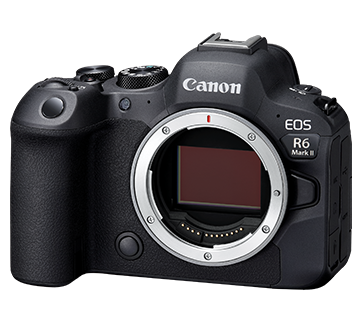
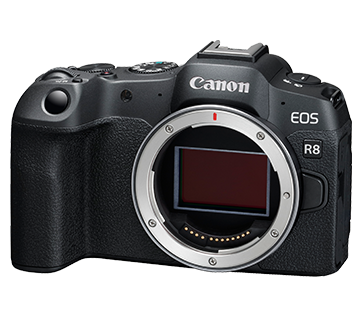
The Canon EOS R6 Mark II and Canon EOS R8 are both full-frame mirrorless cameras that cater to enthusiasts and professionals alike. While they share similar sensor sizes and megapixel counts, they target slightly different user groups, with the R6 Mark II being positioned as a more feature-rich option for advanced users, whereas the R8 serves as a more budget-friendly alternative that still delivers excellent performance. Potential buyers often compare these models to determine which one meets their specific needs, particularly concerning autofocus capabilities, video features, and overall usability.
Specifications Comparison
Detailed Comparison
Image Quality
Both the Canon EOS R6 Mark II and R8 sports a full-frame sensor with a resolution of 24 megapixels, allowing them to capture stunningly detailed images with shallow depth of field. However, the R6 Mark II offers an impressive ISO range expanding up to 204800 compared to the R8's maximum of 102400. This wider ISO capability in the R6 Mark II gives it a leg up in low-light scenarios, allowing for cleaner images at higher ISO levels. Additionally, users have noted that the R6 Mark II exhibits better noise control at high ISO settings, which can be crucial for night photography or indoor shooting in low light. The dynamic range and color accuracy produced by both cameras are commendable, with Canon's renowned color science delivering vivid and pleasing skin tones, making both models great for portraits. Nevertheless, the R6 Mark II's superior performance in challenging lighting conditions slightly elevates its image quality capabilities, particularly when shooting in varying environments. Thus, while both cameras are capable of high-quality image capture, the R6 Mark II holds a slight edge in this regard.
Autofocus System
The autofocus systems of both cameras are impressive, but the R6 Mark II surpasses the R8 significantly with its 4897 AF points compared to the R8's 1053 points. This large number of focus points allows for greater flexibility and reliability in tracking fast-moving subjects, making the R6 Mark II an excellent choice for sports and wildlife photography. In practical use, users have celebrated the R6 Mark II's Eye AF capabilities for both humans and animals, delivering quick and accurate focus even in difficult lighting conditions. In contrast, while the R8's autofocus system is still competent, it does not match the nuance and depth of coverage provided by the R6 Mark II. The more extensive AF system of the R6 Mark II is particularly useful for capturing fleeting moments and ensures that critical focus is achieved more reliably in a wider variety of situations. Therefore, when considering autofocus performance as a critical factor, the R6 Mark II is the clear winner.
Video Capabilities
Both cameras excel in video recording, offering 4K video at 60p. However, the R6 Mark II also features full-frame 4K recording without any crop, providing a wider field of view, which filmmakers and content creators often prefer. In contrast, the R8 may display cropping during filming, which may not be ideal for certain types of video work. Another key differentiator is the R6 Mark II's in-body image stabilization (IBIS), rated at up to 8 stops, allowing for more stable handheld video capture and reducing the likelihood of shaky footage during dynamic shooting environments. In addition to stabilization, the R6 Mark II supports features such as C-Log for better color grading in post-production, making it suitable for more professional video workflows. While the R8 is more than capable for casual videographers and offers solid video quality, it lacks the advanced features that make the R6 Mark II a more robust option for serious videographers. Therefore, for video capabilities, the R6 Mark II takes the edge due to its versatile performance and additional features.
Build & Ergonomics
When it comes to build quality, both the R6 Mark II and R8 boast durable weather-sealed bodies, making them suitable for challenging shooting conditions. The R6 Mark II is slightly heavier at 670g compared to the R8's 461g, which may matter for users intending to shoot for extended periods. However, the build quality of both cameras feels premium, with well-placed controls that facilitate easy handling and operation. The dimensions of the R6 Mark II, while larger, accommodate a more substantial grip that many photographers find comfortable. The screens on both models are identical with a 3-inch, 1,620,000-dot resolution, providing clear and vibrant displays for image playback and settings adjustment. Electronic viewfinder quality is also comparable in terms of refresh rates and clarity, but the R6 Mark II provides a larger physical footprint which some users prefer. Overall, both models present excellent ergonomics, but the R6 Mark II edges out with its comfort and handling for prolonged use.
Battery & Storage
In terms of battery life, the R6 Mark II offers an impressively longer lifespan, rated at approximately 580 shots compared to the R8, though Canon has not disclosed its total shot capacity. For photographers and videographers, this extended battery capacity can be essential for long shooting sessions without needing frequent recharges. Additionally, both models utilize Canon's RF mount, which means that users have access to a wide range of high-quality lenses that will work seamlessly across both cameras. From a storage perspective, both cameras support dual SD card slots (SD UHS-II), providing ample storage for larger files, including 4K videos and high-resolution images. This feature is critical for professional users who require redundancy for their work. Overall, when factored into the user experience, the R6 Mark II stands out for its superior battery life, giving it an advantage for sustained shooting needs.
Value for Money
The Canon EOS R8 is positioned at a lower price point of $1499, making it an appealing option for budget-conscious users who want full-frame capabilities without breaking the bank. Its specifications provide strong performance for casual photography and videography, making it an excellent entry point into Canon's mirrorless ecosystem. Users looking for a lightweight camera with solid basic features will find the R8's value quite compelling. Conversely, while the R6 Mark II commands a higher price, it offers significantly better performance in critical areas such as autofocus, image stabilization, and overall usability for advanced users. For professionals or serious enthusiasts, the additional investment in the R6 Mark II may justify its overall superior capabilities and longevity in terms of performance. Ultimately, buyers should consider their intended use cases and budget, but for those seeking premium features and the best performance, the R6 Mark II delivers robust value despite its higher cost. Therefore, the R8 stands out as a value option, but the R6 Mark II offers better return in performance for its price.
Our Verdict
The overall winner is the Canon EOS R6 Mark II, thanks to its superior autofocus system, enhanced image quality in low light, advanced video capabilities, and robust build quality. These strengths position the R6 Mark II as the ideal choice for professionals and serious enthusiasts who prioritize performance. On the other hand, the Canon EOS R8 presents a compelling option for those on a budget who need the benefits of full-frame technology and solid video performance without the advanced features. Each camera offers distinct advantages that cater to different types of photographers, making the choice largely dependent on individual needs and use cases.
Canon EOS R6 Mark II
Canon EOS R8
Also Compare
Frequently Asked Questions
Is the Canon EOS R6 Mark II worth the extra money over the R8?
If you require advanced features such as superior autofocus, in-body stabilization, and better performance in low-light conditions, the R6 Mark II justifies its higher price. For budget-conscious users doing basic photography, the R8 offers excellent value.
Which camera is better for video shooting?
The R6 Mark II is better for video thanks to its additional stabilization features and no crop in 4K recording, providing smoother footage and a wider field of view.
Can I use existing Canon RF lenses on both models?
Yes, both the R6 Mark II and R8 use the Canon RF mount, allowing you to use the same lenses across both cameras without compatibility issues.
How do the autofocus systems compare in real-world scenarios?
The R6 Mark II's much larger number of autofocus points allows it to track subjects more effectively in fast-moving situations, whereas the R8 may be more reliable for general still photography.
What is the battery life like on the R8 compared to the R6 Mark II?
The R6 Mark II offers a significantly higher battery life rated at around 580 shots, while the R8's life has not been specified but is generally less, making the R6 Mark II better for lengthy shooting sessions.