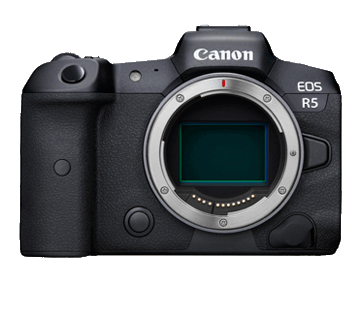
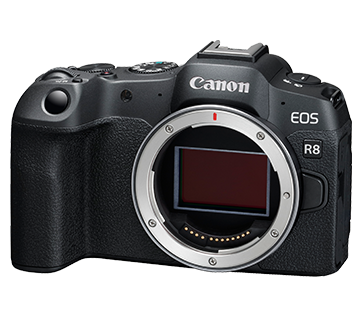
The Canon EOS R5 and Canon EOS R8 are two well-known models in Canon's mirrorless lineup, consistently appearing in discussions around high-performance photography. The EOS R5, launched in 2020, is positioned as a flagship model with advanced features catering to professionals. On the other hand, the EOS R8, released in 2023, is designed as a more affordable option while still retaining some of the core advantages of full-frame mirrors in a lighter package, making it appealing to enthusiasts and emerging creatives. This comparison helps prospective buyers understand the suitability of each camera based on their specific needs, emphasizing the differing specifications, prices, and intended use cases.
Specifications Comparison
Detailed Comparison
Image Quality
The Canon EOS R5 boasts a high-resolution 45-megapixel full-frame sensor, offering stunning details and rich tonal quality that truly shines in large prints or cropping scenarios. It also provides a wider ISO range of 100-51,200, expandable to 102,400, which enhances its performance in low-light conditions. In contrast, the EOS R8 features a 24-megapixel sensor that captures excellent images as well but may not capture as much detail as the R5, especially in challenging lighting. While the R8's ISO range of 100-102,400 also allows for solid performance in low light, the differences in megapixels can be critical for photographers needing the highest possible resolution. Overall, the R5 excels in versatility and detail, particularly for higher-end photography needs, while the R8 offers adequate quality for most users.
Autofocus System
Both the EOS R5 and EOS R8 come equipped with Canon's impressive Dual Pixel autofocus technology, providing a total of 1,053 autofocus points that deliver fast, accurate focus. This robust system is useful in both static and moving subjects, making either camera a strong contender for action photography. However, the R5 has a more advanced autofocus feature set, including Eye AF for humans and animals, which enhances its capability in portraiture and wildlife photography. The R8 shares much of the same autofocus performance, but it lacks some of the more advanced features available in the R5, giving a slight edge to the latter for professionals seeking critical accuracy. Therefore, while both cameras perform admirably, the R5 offers distinct advantages for specific genres of photography.
Video Capabilities
When it comes to video performance, the Canon EOS R5 far surpasses the R8. It supports 4K video recording at an impressive 120 frames per second, allowing for stunning slow-motion footage, as well as the ability to shoot in 8K resolution, making it highly appealing for filmmakers and content creators. Additionally, the R5 includes in-body image stabilization (IBIS), which compensates for camera shake during handheld shooting, a crucial feature for dynamic video work. In comparison, the EOS R8 can record 4K video but at a maximum of 60 frames per second, which may suffice for many situations but does not approach the R5's capabilities. The absence of stabilization on the R8 is another trade-off that video creators need to consider. Overall, the R5 is clearly designed with high-level video production in mind, while the R8 is more suited to hobbyist filmmakers.
Build & Ergonomics
The Canon EOS R5 is larger and heavier, weighing 738 grams and measuring 138 x 98 x 88 mm, which could be a consideration for users who prioritize portability. Its robust weather sealing ensures durability in various shooting conditions, making it a preferred choice for outdoor photographers. The R8, however, is significantly lighter at 461 grams, with compact dimensions of 133 x 86 x 70 mm, making it an excellent choice for those looking for a lightweight camera without sacrificing too much in terms of performance. Both cameras feature an electronic viewfinder and LCD screen, although the R5's screen is larger and has a higher resolution (3.2" 2,100,000 dots vs. 3" 1,620,000 dots), offering better clarity and detail when composing shots. In this case, photographers must weigh the importance of portability against the benefits of a more rugged body.
Battery & Storage
The Canon EOS R5 offers a battery life rated at approximately 320 shots, which is decent but can be limiting for users doing extended shoots without the ability to recharge. The R8 performs slightly better with comparable battery life given its more power-efficient design. Both models utilize the Canon RF mount, providing access to a wide selection of lenses. Nevertheless, the storage options present a difference as the R5 supports dual card slots that allow simultaneous or backup recording, a significant advantage for professional photographers working on important projects where redundancy is critical. The R8, however, has a single card slot, which may be more than adequate for enthusiasts but could restrict workflow for those shooting high volumes of images or video.
Value for Money
Pricing is one of the most significant differentiators between the R5 and R8, with the R5 retailing at approximately $3,899, positioning it as a premium camera aimed at professionals and serious enthusiasts. In contrast, the R8 is priced at a more accessible $1,499, making it a strong contender for those who need a full-frame camera without the advanced features of the R5. When considering value, the R8 provides an excellent entry point into full-frame photography with its competent image quality and good performance for casual shooters. However, depending on the user's specific needs, particularly for professionals requiring extensive features like 8K video and extensive autofocus functions, the R5 could justify its price for such users. Overall, the choice in value will vary widely based on individual priorities.
Our Verdict
In conclusion, while both the Canon EOS R5 and R8 have their strengths, the R5's superior image quality, advanced autofocus capabilities, and excellent video features establish it as the leader overall. It caters more effectively to professional photographers and filmmakers who demand high performance and reliability. Conversely, while the R8 offers unique advantages in terms of affordability and lightweight design, making it suitable for enthusiasts or those new to full-frame photography, it does not match the R5's higher-end specifications. Therefore, for those whose needs align with high-performance photography and videography, the R5 is clearly the better choice.