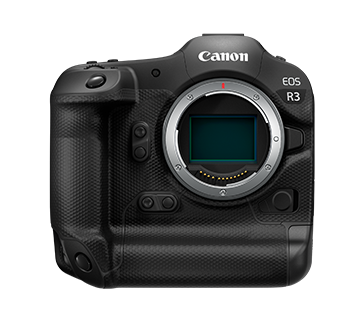

The Canon EOS R3 and Sony A9 II are two high-performance mirrorless cameras that are often compared by professional photographers and serious enthusiasts, particularly those who work in dynamic environments like sports or wildlife photography. Both feature impressive specifications that cater to fast-paced shooting and high-quality output, making them top contenders in their class. The choice between these two cameras largely boils down to specific needs, preferences in handling, brand loyalty, and ecosystem compatibility.
Specifications Comparison
Detailed Comparison
Image Quality
Both the Canon EOS R3 and the Sony A9 II feature 24-megapixel full-frame sensors, providing excellent image quality with rich detail and dynamic range. The Canon's ISO range extends from 100 to 102400, expandable up to 204800, which offers greater flexibility in low-light conditions compared to the Sony's ISO range of 100 to 51200, also expandable to 204800. This means that photographers who often work in varying lighting conditions may favor the R3 due to its superior low-light performance.
In terms of color science, Canon has a reputation for producing warm and natural color tones, which some users may prefer for skin tones and landscapes. Sony, on the other hand, provides a slightly more neutral palette, which gives users more latitude in post-processing. In practice, the image quality from both cameras is exceptionally good, and they each can produce striking results in various scenarios.
Ultimately, while both cameras excel in image quality, the R3's superior high ISO handling could be a determining factor for professionals shooting in challenging lighting.
Autofocus System
The Canon EOS R3 boasts an impressive autofocus system with 1053 autofocus points, significantly outperforming the A9 II's 693 points. This extensive coverage allows for more precise focusing, especially in fast-moving situations. Additionally, the R3 utilizes Canon's Dual Pixel CMOS AF technology, enabling reliable eye tracking for both humans and animals. This feature is especially beneficial for wildlife photographers.
In comparison, the Sony A9 II also offers robust autofocus performance with facial and eye detection, making it suitable for portrait and event photography. While its autofocus system is quick and accurate, the fewer points may lose fine detail in more complex scenarios compared to the Canon.
Both cameras provide remarkable focus speed, but the R3's advanced tracking capabilities and point density provide a distinct advantage in fast-paced shooting environments, making it the preferred choice for action-style photography.
Video Capabilities
When it comes to video performance, the Canon EOS R3 offers high-resolution capabilities, supporting 4K video at up to 120p. This high frame rate combined with the option to shoot in 10-bit 4:2:2 makes the R3 a superior choice for videography requiring high frame rates and post-production flexibility. Furthermore, its in-body stabilization is rated at 8 stops, minimizing shakes and jitters during handheld shooting.
In contrast, the Sony A9 II shoots 4K video at a maximum of 30p. While it produces excellent video quality, it falls short of the R3 in terms of frame rate options and overall functionality for professional videography applications. The A9 II does offer good in-body stabilization at 5.5 stops but does not match the capabilities of the R3.
Given these factors, the Canon EOS R3 undoubtedly takes the lead in video capabilities, catering to filmmakers and content creators who demand high-quality video production.
Build & Ergonomics
The Canon EOS R3 is chunkier and heavier at 1015g compared to the Sony A9 II's 678g. This heft can improve stability during shooting but may also lead to fatigue during prolonged use. It features a robust design with a weather-sealed body, making it suitable for challenging outdoor conditions.
The Sony A9 II has a more compact design, making it easier to handle during long shoots or travel. Both cameras are weather-sealed, ensuring durability and functionality in adverse conditions. The R3 features a larger touchscreen with a higher resolution, enhancing user interaction and focusing precision compared to the A9 II's simpler display.
In terms of ergonomics, both systems have their merits; however, the R3's larger body may be appealing for those who prefer a more substantial grip, while the A9 II's lightweight design is ideal for traveling professionals.
Battery & Storage
Battery life is a significant factor for many photographers. The Canon EOS R3 has a battery life of approximately 760 shots per charge, which is slightly better than the Sony A9 II's 690 shots. Both cameras support robust battery conservation features, making them suitable for long shoots.
Regarding storage, the R3 utilizes dual card slots that support CFexpress Type B and SD UHS-II cards, providing faster write speeds and greater storage options for extensive shoots. The A9 II also features dual card slots but is limited to SD UHS-II cards.
In terms of battery life and storage capacity, the Canon EOS R3 has the edge over the Sony A9 II, accommodating the high demands of professional photography and videography.
Value for Money
At a price point of $5999, the Canon EOS R3 is positioned as a premium model, providing extensive features and enhancements that can significantly benefit professional users. Its advanced autofocus system, video capabilities, and robust build make it an attractive option for photographers who require high performance.
On the other hand, the Sony A9 II is priced at $4500, making it a more affordable alternative for photographers looking for excellent performance without the premium price tag. It still offers solid autofocus and image quality that can satisfy many professionals and enthusiasts.
When considering value for money, while the Sony A9 II is more budget-friendly, the extensive features of the R3 may justify its higher price for those who can leverage its capabilities to their full potential.
Our Verdict
The Canon EOS R3 emerges as the overall winner in this comparison due to its exceptional image quality, advanced autofocus system, superior video capabilities, and solid battery performance. It is particularly well-suited for professionals who require a robust tool to navigate dynamic environments. However, the Sony A9 II is a strong contender that offers excellent performance at a more accessible price, making it suitable for those who prioritize value without sacrificing too much on features. Depending on specific needs-whether it's for video work, wildlife photography, or general use-either camera can be an excellent investment.