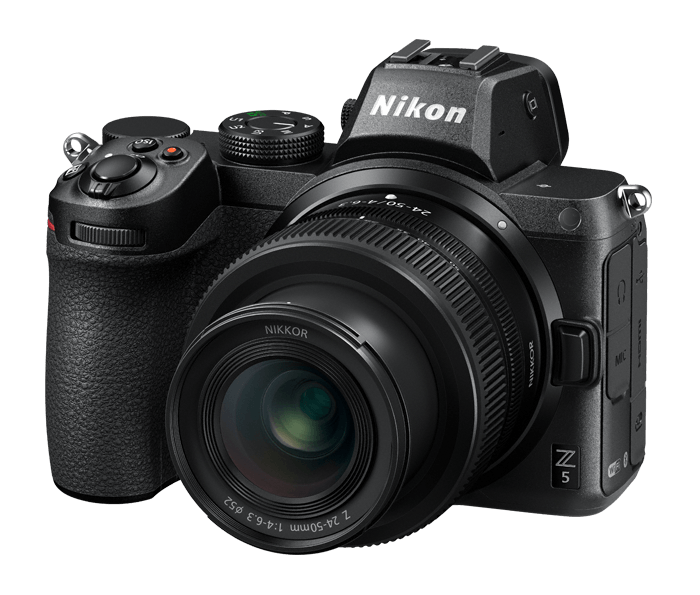
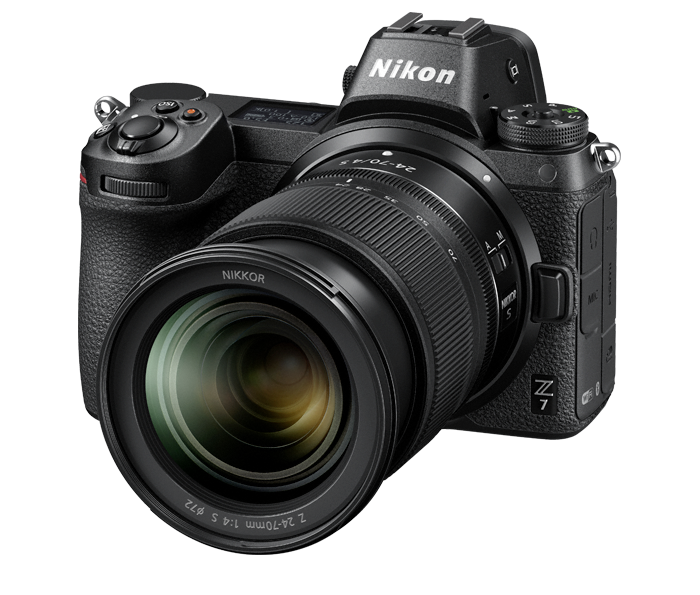
The Nikon Z5 and Z7 are two prominent models in Nikon's full-frame mirrorless camera lineup, catering to different segments of photographers. The Z5, positioned as a more budget-friendly option, is ideal for enthusiasts or those new to full-frame photography who still desire excellent image quality and performance. In contrast, the Z7 targets professional photographers seeking higher resolution and advanced features for detailed imagery. Given their overlapping specifications and performance, many prospective buyers might find themselves comparing these cameras to determine which best suits their needs. Key differentiators include megapixel count, autofocus capabilities, and overall value for money.
Specifications Comparison
Detailed Comparison
Image Quality
The Nikon Z7 boasts an impressive 46 megapixels, significantly ahead of the Z5's 24 megapixels. This increase allows for exceedingly fine details and larger prints from the Z7, making it a preferable choice for landscape and commercial photographers who emphasize resolution. Additionally, the Z7 offers a lower native ISO range, starting from 64, which enhances performance in well-lit conditions, yielding cleaner images with less noise. Both models, however, share a full-frame sensor size of 35.9 x 23.9 mm, providing a similar depth of field and performance in low-light situations when ISO settings are increased.
Despite the Z5's lower resolution, it still produces excellent image quality suitable for most applications, especially for those who do not require ultra-high resolution. The Z5's ISO performance, which extends to 102400, also provides flexibility in lower-light settings, though less effective than the Z7 at higher ISO settings. Essentially, while the Z7 excels in sheer image detail, the Z5 offers a well-rounded performance that adequately meets the needs of many photographers.
Autofocus System
The Z7's autofocus system significantly surpasses that of the Z5, featuring 493 focus points compared to the Z5's 273. This greater number of focusing points translates into enhanced coverage across the frame and superior tracking of moving subjects, making it ideal for action photography and wildlife shooting. The Z7's autofocus performs exceptionally well in low-light conditions, benefiting professional users who require precision in demanding environments.
On the other hand, the Z5, while not as sophisticated, offers competent autofocus performance suitable for general photography tasks. Its 273 autofocus points are adequate for most typical shooting scenarios, such as portraits and landscapes. The Z5's autofocus may struggle slightly in challenging lighting or fast-moving subjects compared to the Z7. Consequently, those who prioritize fast and reliable autofocus will find the Z7 to be the superior option.
Video Capabilities
Both the Nikon Z5 and Z7 offer 4K video recording at 30 frames per second, making them suitable for many videography applications. However, the Z7 features enhanced video quality due to its higher resolution sensor, allowing for more cropping flexibility in post-production. This allows videographers to frame their shots with precision while maintaining high image quality. Moreover, the Z7 can accommodate more advanced video features, such as higher bitrate options and electronic video stabilization, making it a more attractive choice for serious filmmakers.
Conversely, while the Z5 has similar video capabilities, it lacks some of the advanced features and flexibility found in the Z7. Its video functionality is still robust, allowing for high-quality full-frame 4K footage, but it may not satisfy the high-end videographers who seek the utmost in quality and control.
Build & Ergonomics
Both cameras share similar dimensions (134 x 101 mm), but the Z5 is slightly thicker, which may slightly affect handling. They both weigh the same at 675 grams, providing a solid build quality that is weather-sealed, allowing photographers to shoot in varied conditions without worry. The ergonomics of both cameras are well thought out, featuring comfortable grips and intuitively placed controls, catering to extended shooting sessions.
The Z7 is equipped with a higher resolution electronic viewfinder, providing clearer and more detailed previews of images. The Z5's viewfinder is still excellent but offers fewer dots (1,040,000 vs 2,100,000), leading to a minor advantage in the Z7 for professionals who rely heavily on the EVF for precision. Overall, while both cameras feel durable and reliable, the slight enhancements in the Z7 cater better to professional use scenarios.
Battery & Storage
In terms of battery life, the Z5 outperforms the Z7 with a rated longevity of approximately 470 shots compared to the Z7's 330 shots per charge. This advantage makes the Z5 a more suitable option for extended shooting sessions or on-location work where charging facilities may not be readily available. Both cameras use the same EN-EL15c battery, making it easy for users to share batteries across models if they own both.
While both cameras support dual memory card slots (a major plus for professional use), the Z7's slots are compatible with CFexpress cards which can provide faster write speeds compared to the SD UHS-II slots in the Z5. Therefore, users focusing on rapid high-resolution photography or 4K video recordings might lean towards the Z7 for its superior handling of high-speed data. However, the longer battery life in the Z5 offers a compelling reason for casual users or those focusing on still photography.
Value for Money
The Z5's price point of $1,399 presents a significant advantage for budget-conscious photographers, especially considering its capabilities as a full-frame camera, which still offers excellent image quality and performance for most types of photography. It serves as an entry point into full-frame photography and makes exceptional sense for enthusiasts who prioritize value over high resolution and advanced features.
In contrast, the Z7's higher price of $3,399 is justified by its superior image quality, enhanced autofocus system, and added functionalities that cater specifically to professionals and serious enthusiasts who need more from their equipment. While the Z7 can yield better results in certain scenarios, the question remains whether the added cost aligns with the intended use. Those looking for a cost-effective solution without compromising too much on quality will find the Z5 to be a better investment.
Our Verdict
While the Nikon Z7 excels in image quality, autofocus capabilities, and videography features, the Nikon Z5 presents a compelling choice for those seeking a full-frame camera at an affordable price. Its longer battery life and excellent overall performance make it a strong contender for everyday use, especially for photographers who do not require the high resolution and advanced features of the Z7. The Z7, however, remains an outstanding option for professionals who will take full advantage of its capabilities. Ultimately, the choice hinges on specific user needs: budget and versatility for the Z5, versus resolution and advanced functionality for the Z7.
Nikon Z5
Nikon Z7
Also Compare
Frequently Asked Questions
Is the Nikon Z5 good for low-light photography?
Yes, the Nikon Z5 performs well in low-light conditions thanks to its full-frame sensor and extended ISO range. While it may not match the Z7 in terms of clarity at high ISOs, it still provides satisfactory results for most users.
Which camera has better autofocus performance?
The Nikon Z7 has a superior autofocus system with 493 points, enhancing tracking capabilities and performance, especially in low-light and dynamic scenarios.
Do both cameras support 4K video recording?
Yes, both the Nikon Z5 and Z7 support 4K video recording at 30 frames per second, making them suitable for videographers, although the Z7 offers more advanced features.
What are the main differences in battery life?
The Nikon Z5 has a significantly better battery life with approximately 470 shots per charge, whereas the Z7 is rated for 330 shots, making the Z5 more efficient for prolonged shoots.
Are the lenses compatible between the two models?
Yes, both cameras utilize the Nikon Z mount, allowing for full compatibility with Nikon Z lenses regardless of the camera model.