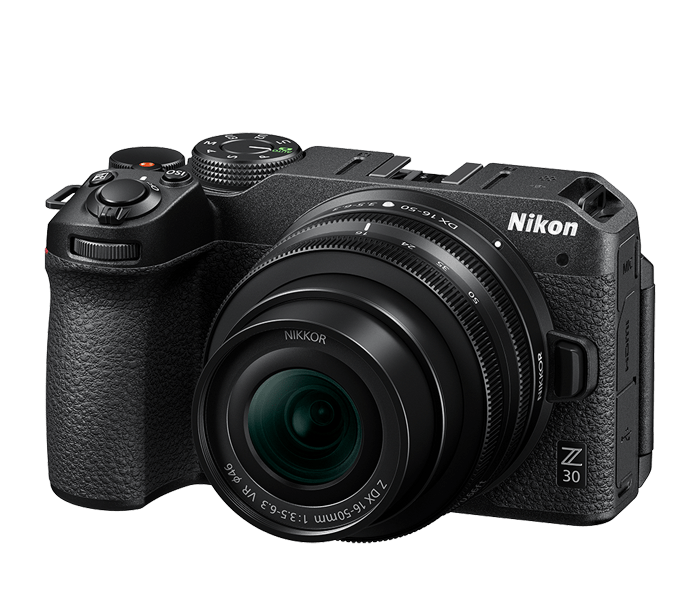

The Nikon Z30 and Sony A6700 are two popular contenders in the APS-C mirrorless camera market, frequently compared by aspiring photographers and videographers looking for an upgrade. Both cameras cater to a specific audience; the Z30 appeals to content creators such as vloggers and YouTubers seeking user-friendly features, while the A6700 targets enthusiasts and professionals desiring more advanced capabilities. Their differing specifications make choosing between the two a pivotal decision based on individual needs and preferences.
Specifications Comparison
Detailed Comparison
Image Quality
When examining image quality, the Sony A6700 stands out with its higher resolution of 26 megapixels, compared to the Nikon Z30's 21 megapixels. This increase enables the A6700 to capture more detail, which is especially beneficial for large prints or cropping in post-production. However, the Z30 supports a wider ISO range, extending from 100 to 51200 and expandable to 204800, which may attract users who frequently operate in low-light environments. The increased capabilities in low-light performance can lead to cleaner images at high ISO settings for the Z30. In practice, both cameras deliver excellent image quality, but each excels in different scenarios: the A6700 is ideal for detail, while the Z30 is advantageous for low-light shooting.
Autofocus System
The autofocus system is one of the most critical aspects for any camera, especially for action and video work. The A6700 outshines the Z30 with its impressive 759 autofocus points, which provide a more comprehensive coverage and faster focusing speeds, making it more reliable for tracking moving subjects. Meanwhile, the Z30, despite having 209 autofocus points, still maintains decent focusing capabilities for casual use and vlogging. However, it can't compete with the versatility and precision of the A6700's autofocus system, particularly in dynamic shooting situations, which makes the A6700 the preferred choice for users who prioritize fast and accurate autofocus.
Video Capabilities
Video features are becoming increasingly crucial in modern cameras, and here the Sony A6700 boasts a significant advantage. It offers 4K recording at a stunning 120 frames per second, which allows for high-quality slow-motion capture and greater flexibility in post-production. In contrast, the Z30 maxes out at 4K 30p, which may suffice for standard video creation but lacks the performance needed for advanced video work. Additionally, while the A6700 includes in-body image stabilization, the Z30 does not have any stabilization, which could result in shaky footage without the use of a gimbal or steadicam. Hence, the superiority of the A6700 in video recording capabilities makes it the clear winner for filmmakers and content creators.
Build & Ergonomics
Both cameras boast weather-sealed bodies, which is a crucial feature for photographers shooting outdoors in various conditions. The Z30 is slightly lighter at 405 grams compared to the A6700's 493 grams, which may appeal to those prioritizing portability. The dimensions also reflect a slight difference, with the Z30 being more compact, making it very suitable for travel and vlogging. However, the A6700's electronic viewfinder provides a more immersive shooting experience, especially in bright conditions where an LCD screen may be hard to see. Ultimately, users may have personal preferences regarding ergonomics, but neither camera significantly outperforms the other in build quality.
Battery & Storage
In terms of battery life, the Sony A6700 offers a substantial advantage with a rating of 570 shots on a single charge, compared to the Z30's 330 shots. This is particularly beneficial during long shooting sessions, especially for content creators who often shoot for extended periods. Both cameras use SD cards for storage; however, the A6700 supports UHS-II, allowing for faster read and write speeds which can be critical when shooting in burst mode or recording high-bitrate video. The superior battery life and storage capabilities of the A6700 give it a clear edge for users who experience intense shooting scenarios.
Value for Money
The Nikon Z30 comes with a price tag of $710, making it a more budget-friendly option compared to the $1400 price point of the A6700. For many users, particularly beginners or those primarily focusing on vlogging, the Z30 offers sufficient features and performance at a more accessible price. However, the A6700, while more expensive, offers advanced video capabilities, superior autofocus, and better overall performance in various shooting conditions. Buyers who are focusing solely on price might be inclined toward the Z30, while those looking for advanced features and higher quality may justify the investment in the A6700.
Lens Ecosystem
Both Nikon's Z mount and Sony's E mount have their own ecosystems of lenses. The Z30 has access to Nikon's growing range of Z-mount lenses, which offer good quality but may not be as extensive as Sony's E-mount selection, which has been established for a longer period. Users interested in versatility might find the Sony A6700 more appealing due to the wider range of lens options and third-party compatibility available with Sony cameras. This consideration is particularly important for photographers who want to explore different types of photography without being restricted. Therefore, in terms of lens ecosystem, the A6700 takes the lead due to its more established market.
Our Verdict
Overall, the Sony A6700 emerges as the preferred option for users seeking advanced features, particularly in video capabilities and autofocus performance, making it suitable for both enthusiasts and professionals. While the Nikon Z30 offers excellent value for budget-conscious buyers and is well-suited for casual photography and vlogging, it lacks some of the advanced features present in the A6700. Thus, photographers and videographers looking for high performance, increased flexibility, and superior image quality should consider the A6700, while those with budget constraints may find the Z30 perfectly sufficient for their needs.
Nikon Z30
Sony A6700
Also Compare
Frequently Asked Questions
Is the Nikon Z30 good for beginners?
Yes, the Z30 is designed with beginner users in mind, featuring a simple interface and good image quality at an accessible price point.
Does the Sony A6700 have in-body stabilization?
Yes, the A6700 features 5 stops of in-body image stabilization, making it a great choice for handheld shooting and video.
What are the advantages of the A6700 over the Z30?
The A6700 has better autofocus performance, higher video frame rates, and a greater selection of lenses, offering significant advantages for serious photographers and videographers.
Can I use Nikon lenses on the Z30?
Yes, you can use Nikon Z mount lenses with the Z30, which provides access to a growing range of high-quality glass designed for this camera.
Which camera is better for travel photography?
While both cameras are compact and weather-sealed, the Z30 is lighter and more affordable, making it a great option for travel photography. However, the A6700 may offer better performance in diverse shooting conditions and in low light.