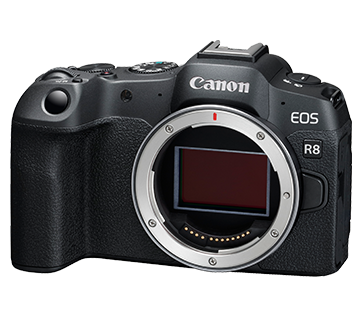
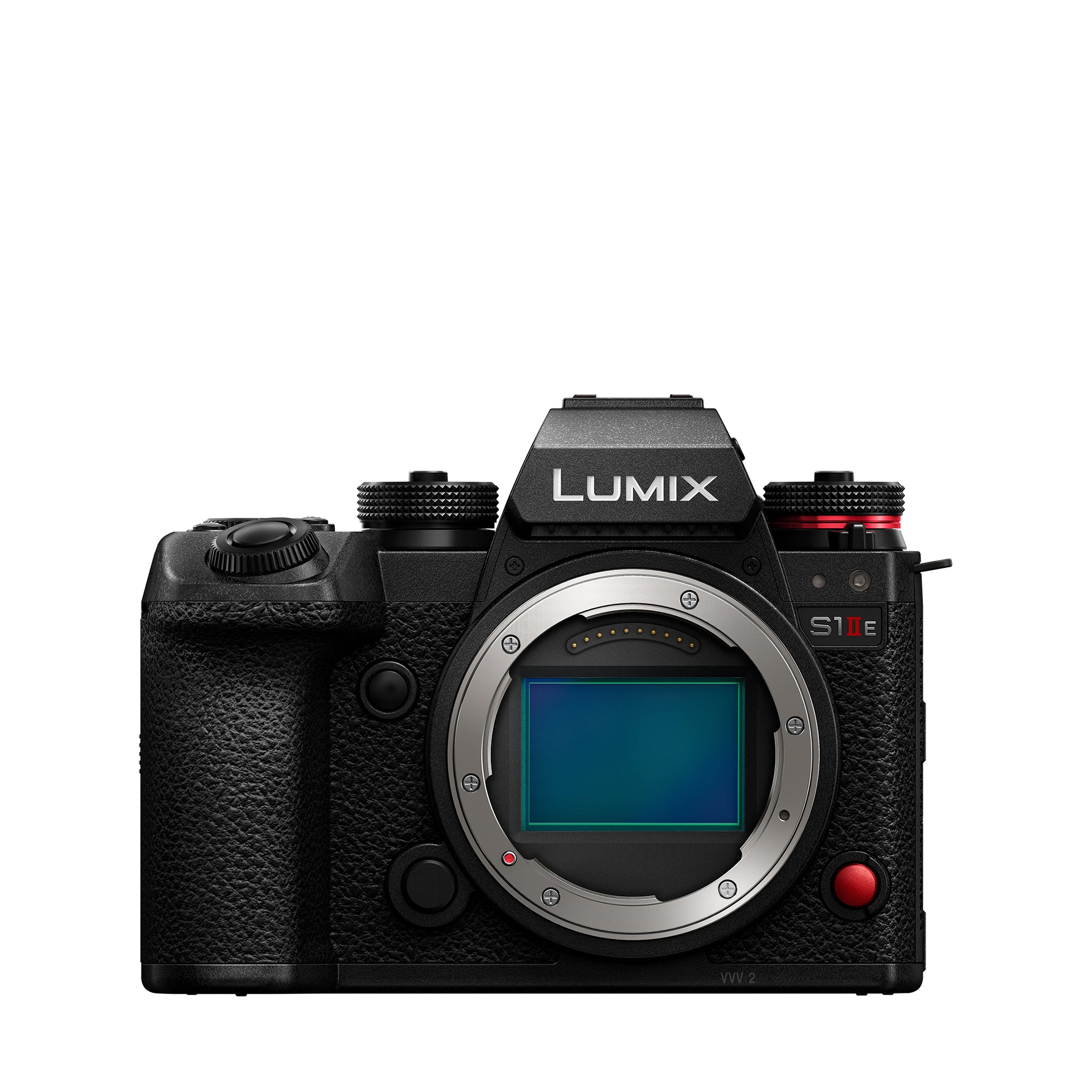
The Canon EOS R8 and Panasonic S1 II E are two formidable contenders in the full-frame mirrorless camera segment, appealing to photographers and videographers alike. Potential buyers are often caught between these two models due to their impressive features and capabilities tailored to both still photography and high-resolution video recording. The key differentiators lie in the design philosophy behind each camera, with the Canon focusing on portability and user-friendliness, while the Panasonic emphasizes versatility and advanced video functionalities.
Specifications Comparison
Detailed Comparison
Image Quality
Both the Canon EOS R8 and Panasonic S1 II E sport full-frame sensors with similar megapixel counts, with the Canon offering 24MP and the Panasonic slightly edging out at 24.1MP. In terms of ISO performance, the R8 excels with an expansive range from 100-102400, providing better low-light capabilities compared to the S1 II E's unspecified ISO range, making it a preferable choice for those shooting in challenging lighting conditions. Additionally, users have reported that Canon's color science produces appealing skin tones, which serves portrait and event photographers well. Meanwhile, Panasonic's sensor has a reputation for slightly better dynamic range, making it ideal for landscape and high-contrast photography. Thus, while both cameras perform admirably, for low-light scenarios, the Canon has a slight edge.
Autofocus System
The autofocus system is one of the most critical aspects for many users. The Canon EOS R8 features an impressive 1053 autofocus points, leveraging Canon's Dual Pixel AF technology for fast and accurate subject tracking, particularly in continuous shooting scenarios. This makes it a great choice for action shots, children, or wildlife photography. The Panasonic S1 II E, while not providing the exact number of autofocus points, offers 30 fps burst shooting which implies that it can also capture fast-moving subjects, albeit with less advertised sophistication in autofocus tracking. Canon's robust autofocus features in real-world scenarios often result in more reliable and timely focus acquisition, particularly under demanding conditions, which gives it an advantage in this category.
Video Capabilities
When it comes to video capabilities, the Panasonic S1 II E clearly stands out with its ability to capture 5.9K/60p, 5.1K/60p, and 4K at variable frame rates including an impressive 4K/120p for high-frame-rate slow motion. This makes the S1 II E an attractive option for videographers who prioritize high-resolution options and frame rate versatility. In contrast, the Canon EOS R8 can record 4K at 60p but lacks the advanced features offered by the Panasonic, such as multiple high-resolution frame rates. The Panasonic's superior video specifications and versatile recording options make it a more appealing choice for content creators focusing on video work.
Build & Ergonomics
Both cameras feature robust builds, but they cater to slightly different user preferences. The Canon EOS R8 weighs only 461g, making it a lightweight and portable companion for travel photography. Its dimensions also suggest a compact design, suitable for photographers looking to minimize gear burden. On the other hand, the Panasonic S1 II E, while not specified, has a more substantial build that often translates to better handling with larger lenses. It is weather-sealed too, making it durable in various shooting conditions. Those looking for an easy-to-carry option may prefer the R8, while users needing a rugged and substantial camera will lean towards the S1 II E.
Battery & Storage
Battery life can also be a determining factor, especially for long shoots. The Canon EOS R8's battery performance is reliable and should be sufficient for most casual shooters, while specifics on the Panasonic S1 II E's battery performance suggest it may last longer per charge in demanding video shooting scenarios, owing to its higher frames per second capabilities in video. Both cameras support SD card storage, but the S1 II E likely supports more robust data through its advanced video formats and resolutions. Thus, while Canon may win for those needing light and portable solutions, Panasonic's battery longevity, particularly for video work, cannot be understated.
Value for Money
Priced at $1499, the Canon EOS R8 is competitively positioned in the market for photographers who value a lightweight system without compromising significant functionality. It appeals to a broad audience, from amateurs to seasoned pros primarily focused on stills. The Panasonic S1 II E, while potentially offering better video features, is likely priced higher based on the advanced specifications it provides. Buyers must consider what they prioritize in a camera - for those needing extensive video capabilities, the cost may be justified. Since the two models serve slightly different market segments, the best value depends on whether one prioritizes photography or video capabilities.
Our Verdict
The Panasonic S1 II E edges out overall due to its superior video capabilities, making it a more versatile choice for those who plan to focus heavily on video production. Nevertheless, the Canon EOS R8 provides excellent value for photographers seeking quality image performance and portability. Thus, while the R8 may be favored by photographers who travel frequently, the S1 II E stands out for creators who benefit from the advanced video functionalities it offers.