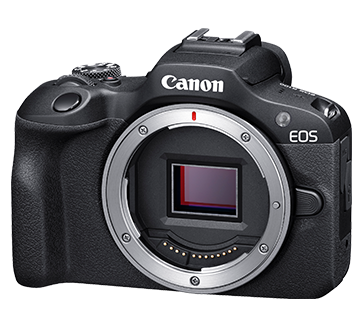

The Canon EOS R100 and the Fujifilm X-T5 are two popular cameras that attract the attention of photography enthusiasts and professionals alike. Canon's R100 is a more budget-friendly option aimed primarily at entry-level users, while Fujifilm's X-T5 is a high-end mirrorless camera designed for serious photographers. Those considering either model are often torn between price and performance, making it crucial to understand the key differences in their specifications and capabilities. Key differentiators include image quality, autofocus performance, video capabilities, and overall usability.
Specifications Comparison
Detailed Comparison
Image Quality
The Canon EOS R100 features a 24MP APS-C sensor, which produces high-quality images suitable for a variety of applications including landscape, portrait, and street photography. However, it lacks some advanced processing features found in higher-end models. On the other hand, the Fujifilm X-T5 has an impressive 40MP APS-C sensor, providing significantly higher resolution images with detailed textures and rich colors-ideal for professional use. The X-T5 also benefits from Fujifilm's renowned Film Simulation modes, which offer unique color profiles that can enhance the aesthetic of images straight out of the camera without extensive editing.
Moreover, the X-T5's ISO capabilities outperform those of the R100. While the R100 has an ISO range of 100-12800, the X-T5's range expands from 125-12800 (and can go as low as 64 and as high as 51200). This allows greater flexibility for shooting in low-light conditions without compromising on image noise. Overall, the higher resolution and superior low-light performance of the Fujifilm X-T5 make it the clear winner in this aspect.
Autofocus System
Autofocus is critical for capturing sharp images quickly, especially in dynamic settings. The Canon EOS R100 sports 143 autofocus points, which provide decent coverage but are limited in comparison to its competitor. In contrast, the Fujifilm X-T5 boasts an impressive 425 autofocus points, offering more precise focus tracking across the frame. This higher number of AF points significantly improves the X-T5's ability to track moving subjects, making it more suitable for sports and wildlife photography.
Additionally, the X-T5 features advanced phase-detection autofocus technology, which can provide faster and more accurate focus acquisition than the EOS R100. In real-world scenarios, this means that users of the X-T5 could find it easier to achieve focus in challenging conditions compared to the R100, further solidifying the X-T5 as the winner in this crucial category.
Video Capabilities
For videographers, the choice of camera can impact the quality of the final product significantly. The Canon EOS R100 allows for 4K video recording but with limitations such as a slight crop and lower bitrate. This might be satisfactory for casual users or those just starting out. However, when comparing this to the Fujifilm X-T5, which offers 6K video recording at higher bit rates and without crop in certain resolutions, it's clear that Fujifilm has placed a strong emphasis on video performance.
Moreover, the X-T5 provides advanced video settings and robust formats, making it a superior option for videographers looking to capture high-quality footage. The inclusion of various frame rates, including 60fps in 4K, further underscores its capability as a serious video tool. In terms of video features and overall performance, the Fujifilm X-T5 clearly stands out.
Build & Ergonomics
In terms of build quality, the Fujifilm X-T5 is weather-sealed, making it more robust against the elements compared to the Canon EOS R100, which lacks such protective features. The X-T5's design also incorporates thoughtful ergonomics, including a customizable interface and a solid grip, providing a comfortable experience during extended shoots.
Although the R100 is more compact and lightweight, making it more portable for casual photography or travel, it might feel less durable compared to the metal and weather-resistant body of the X-T5. Users who prioritize robust build quality may lean towards the X-T5, especially for outdoor or challenging shooting conditions. Therefore, the X-T5 wins in this aspect based on its superior build quality and ergonomic features.
Battery & Storage
The battery life is one area where the Canon EOS R100 performs well given its lower price point. It can comfortably last for several hundred shots on a single charge, making it ideal for casual use when battery changes may not be frequent. However, the Fujifilm X-T5 significantly outperforms the R100 in this category with a battery life of approximately 580 shots, which is beneficial for longer shooting sessions.
Additionally, both cameras support SD card storage; however, the X-T5 supports UHS-II cards, allowing for faster write speeds which are essential for burst shooting and 4K video recording. This capability gives the X-T5 an edge in terms of workflow efficiency and storage management. Overall, the Fujifilm X-T5 leads in battery life and storage performance.
Value for Money
Pricing plays a significant role in the decision-making process for many buyers. The Canon EOS R100 is priced at around $480, which positions it as an attractive entry-level option for beginners. This affordability makes it accessible for those who want to experiment with mirrorless photography without a hefty investment. The X-T5, on the other hand, comes with a price tag of $1699. While it offers superior specifications, such as higher resolution and better performance, it may not be justified for casual users or beginners.
However, for serious photographers or videographers looking for a professional-grade camera, the investment in the X-T5 is often seen as worthwhile due to its enhanced features. Ultimately, for those on a budget or new to photography, the R100 presents better value, while for professionals aiming for quality and versatility, the X-T5 earns its higher cost.
Our Verdict
While the Canon EOS R100 is an excellent choice for those seeking an affordable, lightweight entry point into the world of mirrorless photography, it falls short against the Fujifilm X-T5 in several critical areas, particularly image quality, autofocus, and video capabilities. The X-T5 is designed for enthusiasts and professionals who demand superior performance and quality. Ultimately, both cameras serve their target markets well, but the Fujifilm X-T5 emerges as the overall winner for those who are willing to invest in more advanced features and capabilities.